

You Can’t Build a Product Without Building for People
How design thinking and empathy drive successful product development

If you’re anything like me, you’ll find the process of building products deeply fulfilling, especially when the goal is more about learning the craft of building than anything else.
But here’s the thing: It’s one thing to enjoy creating products, and it’s a completely different challenge to know where to start.
This is where many builders, especially those working with AI tools independently, hit a roadblock.
You’ve got powerful models at your fingertips. You can generate, predict, summarize, and classify. But when it’s time to actually build something, it’s easy to get stuck, not because the tools aren’t powerful, but because you’re unsure what problem you’re solving for people.
That’s where design thinking becomes invaluable. It’s not just a buzzword. It’s a mindset and method that ensures people are at the core of your product. It’s how I turn “this could be cool” into “this solves a real need.”
It adds structure to my work when I’m building alone, and helps me create human-centered products that feel meaningful, even if no one asked for them.
Why Design Thinking Still Matters
With AI, it’s easy to get pulled into the technical side of things like parameters, tokens, prompts, and inference time. Those details matter (and we’ll get to that in a minute.) But they’re not where product thinking begins.
Design thinking reminds you to start on the other side:
What does the user feel? What do they need? What are they trying to get done?
That shift in perspective is huge.
Building with AI is often unpredictable. You don’t always know what the model will generate. You don’t always have perfect data.
What you can control is the clarity of the problem you’re solving and the quality of the experience around it.
This is especially helpful when you’re a solo builder who is working nights, weekends, or in between other things. You may not have a full team, but you can still follow a creative, thoughtful process.
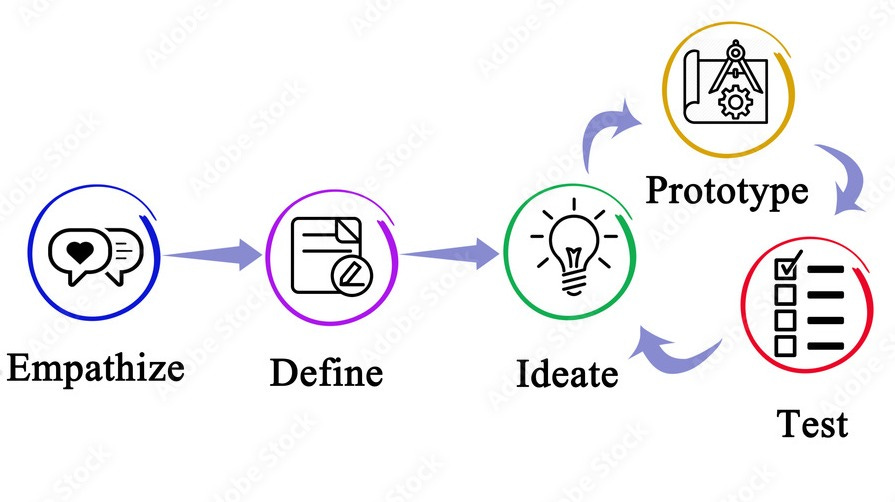
Breaking Down the Design Thinking Approach
Step 1: Start With Empathy (Even When You’re on Your Own)
Empathy doesn’t always mean formal interviews or UX research.
Sometimes, it just means observing the world a little more carefully and listening to the friction in your own or others’ routines.
Ask yourself:
What tasks feel repetitive or draining lately?
What’s something I or someone else keeps putting off?
Where do I see workarounds—copy-pasting, note-taking, reformatting?
Even reading 2-star product reviews, Reddit threads, or Twitter complaints can surface patterns. These aren’t just rants, they’re reflections of real pain points.
If you’re not sure where to start, pick a context you care about, like freelancing, content creation, education, or productivity, and spend an hour gathering little clues.
You don’t need a dataset. You just need a few real frustrations to begin shaping around.
Step 2: Define a Clear Problem, Not Just an Idea
This is where a lot of promising projects get lost: the “solution” comes before the problem is fully understood.
You might have a cool idea like “use AI to write emails,” but unless you know what kind of emails, who’s writing them, and what’s painful about that process, it’ll stay vague.
A clearer definition might be:
“Freelancers need a faster way to write polite follow-ups that don’t sound robotic.”
That’s specific enough to build around.
A good problem definition:
Focuses on a moment or task
Includes emotional context (frustration, confusion, overload)
Leaves room for multiple solutions (not just one feature)
If you can describe the moment where someone would want your product, without needing to explain it, you’re ready to build.
Step 3: Use AI Intentionally, Not Automatically
Once you have a well-defined problem, start asking: What can AI uniquely do here?
This is where your creativity comes in, not by forcing AI into every interaction, but by spotting where it enhances or simplifies.
Some ways AI can help:
Summarize long or chaotic input
Classify or label messy data
Generate content based on templates or tone
Personalize based on a few variables
Predict outcomes or recommend next steps
Ask yourself:
Where in the user flow is someone making a judgment or decision?
Where does something need to be interpreted, rewritten, or condensed?
Where is there inconsistency or subjectivity that AI could smooth out?
AI is often best used as a supporting actor, not the lead. You don’t always have to make an AI product, but you can always leverage it to. Make it the thing that quietly improves the product.
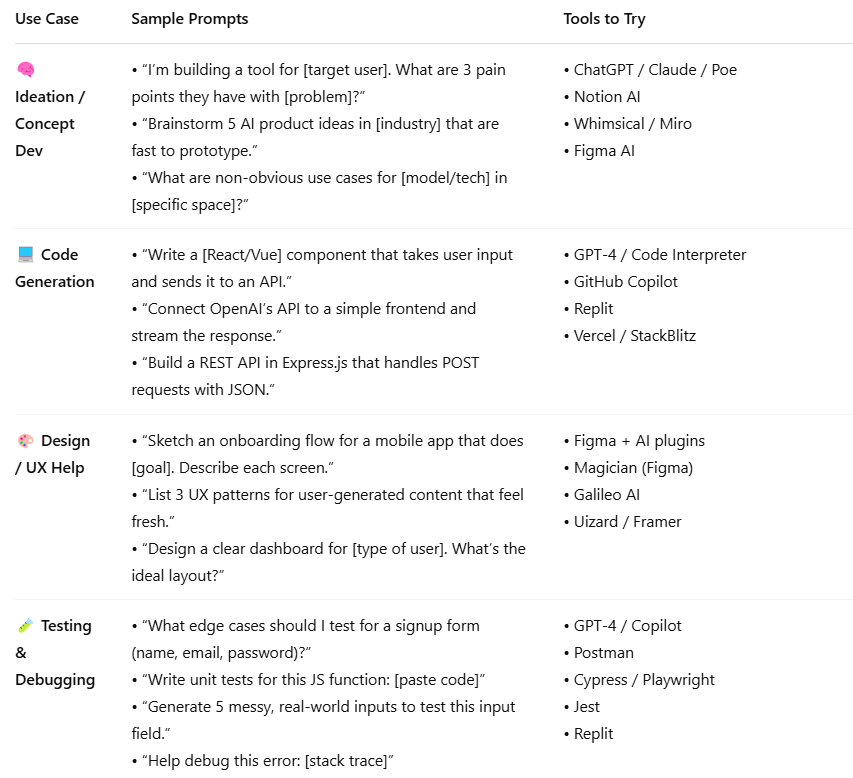
Here are a few ideas of sample prompts and tools you can leverage as you go along the product development process.
Step 4: Prototype What You Can (and Fake What You Can’t)
As a solo builder, your biggest advantage is speed. You don’t need a roadmap or a greenlight. You can try things.
But “prototype” doesn’t mean “perfectly code the whole app.” It means:
Can you simulate what the product might feel like?
Can someone test the idea, even if it’s not live yet?
Can you learn something before investing time in the wrong direction?
Some quick ways to prototype:
Use Figma to sketch the flow
Use GPT to manually simulate what your product would generate
Build a basic front-end and hard-code the AI response
Create a Notion page or Airtable to simulate a backend
Use tools like Replit, Framer, or Glide to get something interactive
The goal is to move from idea → experience quickly enough that you can learn from it.
Step 5: Test the Thing (Even If It’s Just With Friends)
Testing doesn’t need to be formal. Share it with a friend. DM someone who tweeted about a similar issue. Ask:
“Does this solve the problem you’ve had?”
“Would you actually use this—or is it interesting, but not helpful?”
“What confused you or felt off?”
Sometimes people won’t give deep feedback, but watch what they do. Did they open it and never return? Did they get stuck? Did they share it with someone else?
Your job is to figure out what’s resonating, not just what’s functioning.
When you test early, you give yourself space to iterate instead of over-engineering. When you build solo, this loop is your best friend.
Final Thoughts: Why This Method Works
As an AI Product Manager, using design thinking isn’t just about following a set process. It’s about adopting a mindset of empathy, iteration, and creativity. The beauty of design thinking lies in its ability to break down complex problems and turn them into manageable, user-centered solutions, especially when paired with the power of AI.
By embracing a human-centered approach and leveraging AI tools, you can accelerate ideation, prototyping, and testing. You don’t have to wait for perfect conditions to start; instead, use these methods to experiment, iterate, and refine ideas quickly.
More than anything, it helps you care more deeply about the thing you’re making, even if it’s just for you, even if no one else sees it.
Because the best AI products don’t start with a model, they start with a moment.
A need. A curiosity. A little friction is worth fixing.
Author Spotlight
We’re so grateful to
for allowing us to share her story here on Code Like A Girl. You can find her original post linked below.
If you enjoyed this piece, we encourage you to visit her publication and subscribe to support her work!

Join Code Like a Girl on Substack
We publish 2–3 times a week, bringing you:
Technical deep-dives and tutorials from women and non-binary technologists
Personal stories of resilience, bias, breakthroughs, and growth in tech
Actionable insights on leadership, equity, and the future of work
Since 2016, Code Like a Girl has amplified over 1,000 writers and built a thriving global community of readers. What makes this space different is that you’re not just reading stories, you’re joining a community of women in tech who are navigating the same challenges, asking the same questions, and celebrating the same wins.
Subscribe for free to get our stories, or become a paid subscriber to directly support this work and help us continue amplifying the voices of women and non-binary folks in tech. Paid subscriptions help us cover the costs of running Code Like A Girl.
 | A guest post by
|
Walking a mile in your user's shoes is really easy to say and very difficult to do. Thanks for the reminder, Esha, to not hurry this step and to keep it at the heart of any product development.
Everyone’s obsessing over models and prompts, but the real game starts way earlier: a human with a real pain
AI’s the assist. Design thinking is the aim.
Thanks for sharing 🙏