

Why Recognition, Not Just Hard Work, Opens the Next Chapter of Your Career
How one professor’s choice to credit me set me on a path I never expected


The Light Bulb Moment
In my third year of university, I walked into the lecture hall I’d been avoiding for two years, my first computer science course. My friends in the humanities had warned me it was impossibly hard, and for a while, I believed them. But it was a required course for my math degree, so there I was: nervous, resigned, and utterly unprepared for what was about to happen.
Down in front was Dr. Jiping Liu. In his heavily accented English, he began to explain the concepts of computer science, showing us how to build a Hello World program in Java. Next, he showed us some other simple programs. What surprised me was how similar this was to a pure math class solving proofs.
A Giant light bulb went off in my head. Computer science wasn’t scary at all; it was just another syntax for the way I already thought as a mathematician. In that moment, I realized I had always thought like a computer scientist; I just hadn’t known the language yet. Instead of solving abstract proofs, I would be solving real-world problems and building them for other people to use. What a concept!
In that moment, I got excited. The kind of excitement that makes you sit up straighter, scribble faster, and realize you’ve found something that feels like it was always meant for you. I had walked into that room fearful of a requirement, but I walked out having fallen in love with computer science.
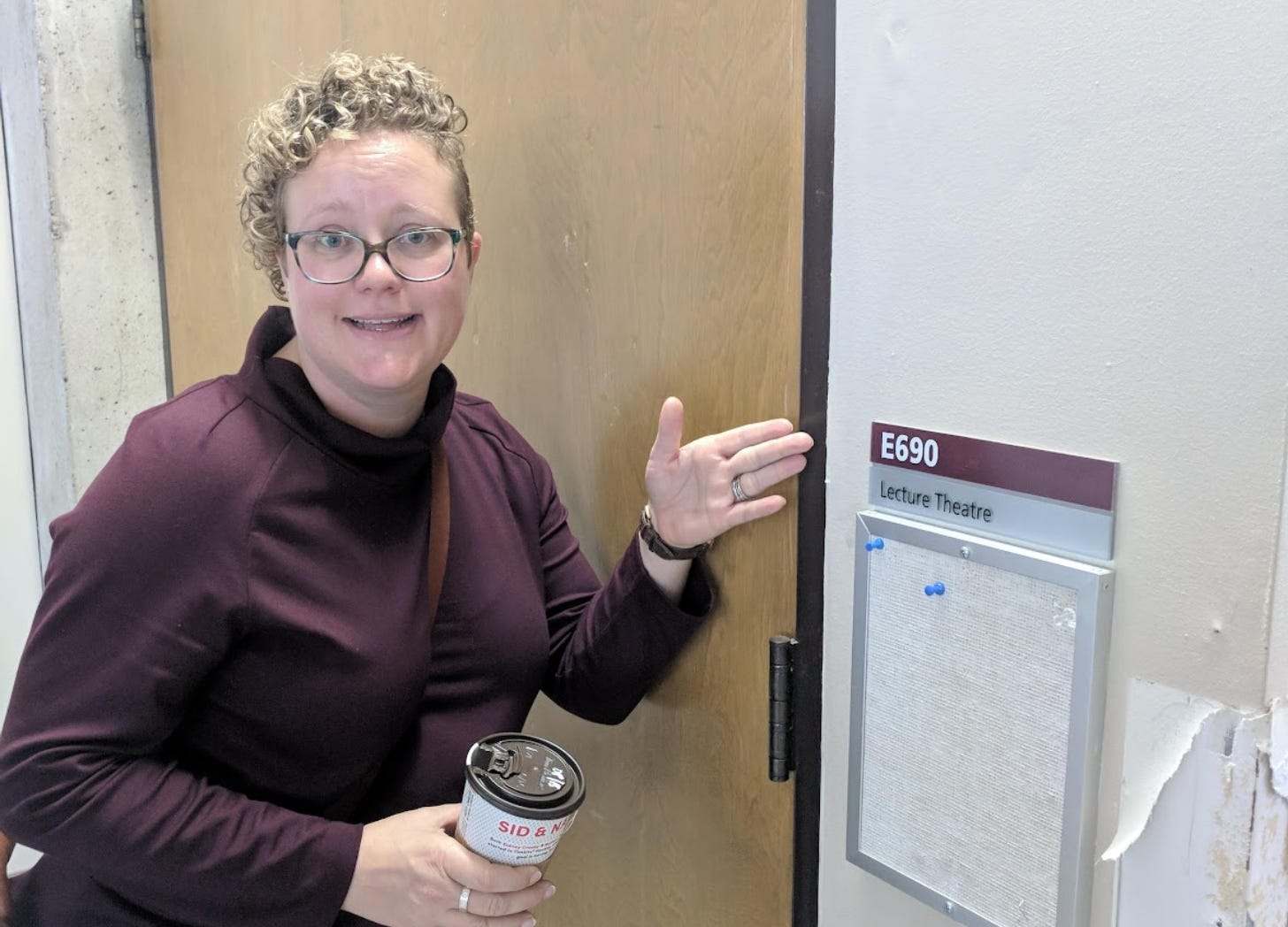
That moment stayed with me for years. When I returned to the University of Lethbridge 15 years later to be inducted into the Honour Society for my work amplifying the voices of women in technology, I felt pulled back to the room where it all began. The door was locked, but standing outside, I couldn’t help thinking how one moment inside had opened up the rest of my life.
Looking for a Way Forward
In the next semester, I also took Dr. Liu’s I C++ course, and as the school year wrapped up, I began to worry about what I would do after finishing my math degree. Since I was no longer planning to be a teacher, I needed to explore other paths. I had heard that summer research positions could be a stepping stone toward graduate school, so I started looking for opportunities. Somewhere in that process, whether through another professor’s suggestion or by approaching him directly, I found myself in conversation with Dr. Liu about a summer research position. He had some funding for one and agreed to take me on!
The Summer that Shaped Me
He was working on a graph theory problem that could benefit from someone writing a C++ program to show a practical solution to the problem. That became my project for the summer. On top of that, I became his Teaching Assistant for the first year of computer science. I was now marking the assignments from a class I had only taken eight months before.
At the end of the summer, when the work was complete, Dr. Liu let me know he would be publishing a paper about this research. The incredible, almost unbelievable part was that he was going to list my name on the paper.

My Name in Print
What?! Do you even know how rare it is for an undergraduate student to be published? Do you know it is even rarer for women to be published, especially at this level?
At the time, I did not fully appreciate how radical it was that Dr. Liu included my name on the paper. Later in my master’s degree program, I would watch professors omit female students' names on papers they helped research and, in some cases, actively remove their names if they didn’t pass their doctoral exam on the first try.
Men in similar situations did not have their names removed. To put it in context, fewer than about one in ten math paper authors were women at the time. In contrast, Dr. Liu’s decision stood out as an act of integrity and allyship, and it changed everything for me.
A Path Unlocked
Being credited on that paper changed the trajectory of my career. When I applied for my master’s degree two years later, it likely helped me get a place at the best university for math and cryptography in Canada, the University of Waterloo. I got to work with the leading minds in cryptography: Dr. Alfred Menezes, Dr. Douglas Stinson, and Dr. Scott Vanstone. I can’t tell you how excited I was to do that. I couldn’t believe I would get to learn from these Crypto Greats.
It also likely helped me secure a full NSERC scholarship for my Master’s program. It wasn’t just about an extra line on my application or resume; it was about legitimacy, validation, and possibility. One professor’s choice validated to the rest of academia that I belonged there. In turn, it gave me confidence to keep going and to believe I belonged in spaces where women like me were often overlooked.
Allies matter.
Recognition matters.
Sometimes, the difference between a name erased and a name remembered is the difference between walking away and finding your path forward.
Gratitude
I will forever be grateful for what Dr. Liu did for me, recognizing me as a person whose work deserved to be seen and included. And every time I think back to that first light bulb moment in his class, I remember how joy and recognition combined to change my life’s direction. Sadly, only six years after that research position, Dr. Liu tragically died in a car accident. The good ones always leave us too soon.
Claiming My Own Voice
We all have moments when we wait to be noticed, just hoping all our good work will speak for itself. But it rarely does. In every career, recognition and credit matter. Research shows that women are less likely to put themselves forward for recognition or to claim credit for their work, even when they have contributed equally. That hesitation has a cost: missed promotions, overlooked opportunities, and invisible labor.
Dr. Liu taught me what it looks like when someone uses their voice to lift others up. For a long time, I relied on people like him to notice my work. It took me years to realize I also needed to be that advocate for myself.
After one particularly awful job, working for a boss who was both a bully and a misogynist, I learned the hard way that silence protects no one. So when I started looking for a new role, I decided to do things differently. I applied through the traditional route, waited a week, and heard nothing. Then I reached out to a friend who worked at the company and asked if he’d be willing to recommend me. That same day, he walked over to the hiring director and said,
“You need to take a closer look at her résumé. She’s really good.”
That small nudge got me an interview, and eventually, the job. Without asking for the recommendation, I might not have secured the interview. The worst that could have happened was silence or a polite no. There was really nothing to lose and everything to gain. It’s not bragging to advocate for yourself; it’s how you make sure your work gets seen.
If you’ve been waiting for someone to notice your work, this is your reminder to stop waiting. Speak up, reach out, and ask for the recognition you’ve earned. Sometimes the opportunity you’re waiting for is just waiting for you to raise your hand.
Opening Doors for Others
Over the years, I’ve done the same for others. Quietly advocating for people whose work I know deserves a chance to be seen. Just last week, a former coworker reached out asking if I knew about any open positions in his field. I did, and I remembered his great work, so I recommended him for the position.
Take a moment to think about the people who helped open doors for you and then about the ones whose work deserves to be seen. Pay it forward. Give credit, speak a name, and make the introduction. It might change someone’s path the way Dr. Liu changed mine.
Author Spotlight
is the founder and editor-in-chief of Code Like a Girl. If you enjoyed this piece, we encourage you to visit her publication and subscribe to support her work!
Join Code Like a Girl on Substack
We publish 2–3 times a week, bringing you:
Technical deep-dives and tutorials from women and non-binary technologists
Personal stories of resilience, bias, breakthroughs, and growth in tech
Actionable insights on leadership, equity, and the future of work
Since 2016, Code Like a Girl has amplified over 1,000 writers and built a thriving global community of readers. What makes this space different is that you’re not just reading stories, you’re joining a community of women in tech who are navigating the same challenges, asking the same questions, and celebrating the same wins.
Subscribe for free to get our stories, or become a paid subscriber to directly support this work and help us continue amplifying the voices of women and non-binary folks in tech.
I am so glad that you found an ally like Dr Liu. This kind of allyship is becoming rarer by the day in academia. When someone has faith in you, it propels you forward with a greater velocity.
Like most women I struggle with beating my own drum but I consciously push myself to because I deserve recognition for the work I put in; I deserve boundaries, and I will protect myself against exploitation; I deserve every bit of the space I occupy.
Thank you for sharing your story and these important reminders!
This is such an inspiring post! It shows how even a seemingly tiny nod of recognition can activate a chemical cocktail in the brain of good feelings for oneself and extra motivation to do better work, and the confidence to ask for things knowing you have quality to offer.