

How one builder rallied thirty creators, survived an AI meltdown, and shipped anyway.
A Conversation with Elena Calvillo about what it took to build the AI Advent Calendar



Five days before launch, Elena almost lost the work of thirty creators had written for her AI Advent Calendar. An AI tool rewrote their lessons into nonsense, her credits were nearly gone, and she had no time left.
That is the part nobody saw.
But the story starts earlier, on November 1, when Elena invited me, Dinah, founder of Code Like A Girl, to contribute. She had built a working demo with one functioning door, just enough to show the idea was real.
I already knew Elena from her writing for Code Like A Girl. She is a former developer turned AI Product Manager, someone who actually builds what she talks about, so when I saw that demo, I knew I wanted in.
A few days later, she sent her contributor guide. It was clear, structured, and thoughtful. It explained exactly what she needed, how it should be formatted, and how to preview a finished door. It made participating simple.
Since December began, I have opened the calendar every morning and learned something new each day. It has become a small bright ritual.
Today, I am talking to Elena about why she built this, how she brought more than thirty creators together, what almost stopped everything, and what she learned while shipping a real product in real time.
Here is our conversation.
Dinah
When you messaged me on November 1 with that first working door, what was going through your mind as you crafted that invitation? It felt energizing without being pushy, and that is exactly what made me want to join.
Elena Calvillo at Product
Honestly? Pure instinct fueled by excitement.
I was reaching out to people I genuinely respected, and of course, they were explicitly working with AI, which was the whole point, so I didn’t want to waste their time with vague “let’s do something cool together” energy. These are busy people. Some are much busier than me. They have families, jobs, and a lot going on.
So my thinking was: What’s the best way that in the minimum amount of time they get up to speed to provide their contributions? How can I help them succeed in this?
That question shaped everything. The invitation. The brief. The timeline. I wanted to make participating as easy as possible because I genuinely believed this could be fun and valuable for everyone involved.
And when people like you, Wyndo, Sam Illingworth , Jenny Ouyang, and others replied so fast with “this is a hell of an idea, I’m in” without us ever really chatting about it before? That fueled me up so much.
That high interest was a great first signal.
Dinah
I totally identify with that. I also jump on projects with vast amounts of energy, and it’s the best when the people that you share it with join in on that excitement! What was the spark behind the AI Advent Calendar? Why this idea, and why now?
Elena Calvillo at Product
I don’t even remember where I was. Maybe walking? Taking a shower? Honestly, the thought just hit me.
But here’s what I DO remember: it started with the calendar itself. I love advent calendars, those little wooden ones with miniature surprises behind each door. And I thought, “Wait, what if this is about AI micro-lessons each day?”
So I prototyped it in Lovable. And here’s the wild part: Lovable generated THE WHOLE CALENDAR by itself. Not just the platform, but the content, the lessons, the prompts, everything.
I looked at it and thought... this feels empty.
Like I imagined myself opening AI-generated lessons for 25 days and felt... bored? There was no emotion in it. No life. It was technically perfect but soulless.
That’s when it clicked: what if real people actually share each lesson?
I don’t care if they’re “professional” enough or perfectly polished. That way, they also get subscribers, attention, and can promote their stuff.
A paid subscription? An ebook? Templates and resources? Give things away? That sounds like much more fun.
And that’s when this stopped being a cool prototype and became something I actually wanted to invest in.
Dinah
I think that personal touch is exactly why this project is resonating so much with people. It feels human, and you can see that in all the amazing notes the community is sharing.
What did this project mean to you personally? Why did you feel compelled to build it even before you knew anyone else would care?
Elena Calvillo at Product
It felt almost like play.
I’ve spent years building products for corporations where every decision gets scrutinized, every feature needs a business case, and everything moves at the speed of approval chains. This was the opposite. No stakeholders to convince. No roadmap committees. Just “this sounds fun, let’s see if it works.”
But here’s what made it personal: I wanted to prove I could still just... build something.
Not for a promotion.
Not for a performance review.
Not because a VP asked for it.
Just because the idea made me excited.
There’s something about having an idea on a random Tuesday and seeing it live by Friday that reminded me why I got into product work in the first place. That immediate feedback loop of “does this actually work?” felt addictive.
And I think deep down, I wanted to know: Can I still do this alone?
After years in big companies with entire teams supporting every launch, could I just ship something myself? Turns out, yeah. I could. And that realization meant more to me than I expected.
Dinah
Your contributor guide blew me away. It told me exactly what you needed and how to deliver it without any confusion. I am curious, was that the first draft, or did you experiment a bit before landing on that version? What was your process for putting it together?
Elena Calvillo at Product
Yes, that was the first draft. It was pure instinct. I didn’t look at other guides or briefs. I searched for them, but I couldn’t find anything that fit!
But here’s my secret weapon: Craft.do
Craft has become my library of knowledge. I do all my writing there, all my collaborations, basically, my life is stored there. It has a great, nice-looking vibe of a modern platform with the power of any markdown writer, but way more versatile than Google Docs.
If I wanted to impress with the brief, I knew I had to do it there.
And the structure came from that same question: How do I help busy people succeed with minimal time investment?
So I made it crystal clear:
What the platform would look like
What their contribution would be
How they’d be credited
What the timeline looked like
Where to send their contributions
I tried to avoid ambiguity as much as possible!
These are the same techniques I use at work, particularly when collaborating with stakeholders and upper management. I learned this technique from one of my previous managers, who was the director of marketing at the time. Because of him, I learned to respect everyone’s time.
So for this contribution, it was simply a matter of knowing what was necessary to participate successfully.
Dinah
What was the moment you knew this project had real momentum, not just polite interest?
Elena Calvillo at Product
The first contributors replied with “This is an amazing idea! I’m in!” within minutes, even before the brief existed. We were just chatting!
I’ve never chatted with some of them before, like Wyndo, Sam Illingworth, and Anfernee.
I also remember Sharyph giving me ideas on how to come up with good prizes. People were building on the concept, not just accepting it. That’s when I knew it had real potential.
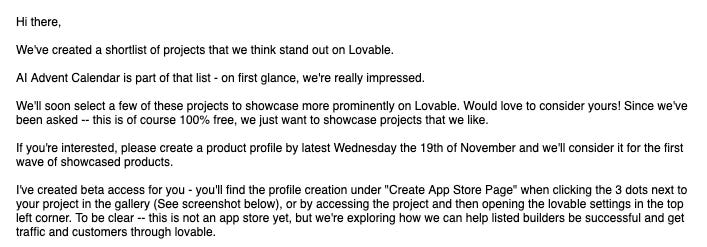
Another moment that hit me was the email from Lovable after I submitted the project to their contest. It sparked so much interest, and they highlighted the creativity behind the project. That external validation, from a platform I was literally using to build the thing, was surreal.
Dinah
Did you ever have a moment where you thought, “If this fails, everyone will see it fail?” How did you handle the vulnerability of building something so public, so fast?
Elena Calvillo at Product
At first, I wasn’t worried about failing publicly on my own. I treated this as a fun experiment. After working in product management for many years, you start to view failure as an inevitable part of the process. You can’t build a roadmap around success!
But once it went viral and I had tons of participation, then I started to worry about letting others down. They’d already invested their time and effort. That responsibility felt real.
If I’d been solo all the way, I wouldn’t have cared as much. But knowing 30+ people trusted me with their work? That changed everything.
I took the whole week of Thanksgiving off from my real job to focus on fixing the PDF content crisis. I’d never done that before. Submitting PTO for a personal project? I surprised myself!
But in my mind, I didn’t have a choice. These people believed in me. I had to show up.
Dinah
Speaking of the PDF content crisis, that was the issue that hit five days before launch and nearly derailed everything. Can you take us back to the moment you first saw the content being rewritten? What was that like?
Elena Calvillo at Product
Anger. Frustration. Immediately.
Like “Why this? And why now?”
But honestly? It was also my fault for trusting the AI completely. Lovable kept telling me,
“I fixed this, it’s working now,”
and
“I uploaded the content, and it’s all there.”
But then I’d check and... it wasn’t true.
It consumed SO many credits in this back-and-forth, with Loveable constantly reassuring me everything was fine when it wasn’t.
That personal frustration with the AI lying to me? That stung.
But as soon as the anger hit, I switched modes. I started validating my options and focused on resolving this smartly.
I messaged many contributors to check their content, validate it, and tell me if it was okay or not. Yes, I had to delegate that to them to give myself space to focus on other fixes.
Some, like Finn Tropy replied with:
“What happened with the prompt I gave you?”
To be fair, Finn’s contribution WAS a mess. IT WAS SUPER CHANGED. Nothing made sense. I appreciate that he was so patient and understanding because if I were in his position, I’d probably be furious. Thanks, Finn!
Also, when I say “resolved this smartly,” I mean each door unlocks each day, so you have your roadmap right there.
There’s no point in fixing door number 24 if the first week is what matters for launch.
I could fix the rest with less rush than the first few days.
My PM instincts kicked in: prioritize ruthlessly, ship what matters, and iterate fast.
Dinah
A lot of people would have walked away at that point. Seriously, a lot of people have incredible ideas, but not many follow through the way you did. Or take time off work to properly fix a side project, even if they made commitments to others.
What kept you going when the easiest choice would have been to quit quietly?
Elena Calvillo at Product
High commitment and PM resilience.
Look, I’m used to failed launches, okay? Those product managers who say “I’ve never missed a launch” or “I haven’t had an unsuccessful launch” are completely lying! Or they’re shipping into another world, because reality hits very hard and different.
But this was different because I’d made commitments to 30+ people. If I’d been solo the whole way, I might have walked away. But knowing they’d trusted me with their time and work? That responsibility kept me going.
Also, the anger and frustration turned into determination pretty fast. I’m used to fires. This was just another one. You assess options, prioritize, and execute. That’s the job.
Dinah
You rebuilt the platform under intense time pressure. How did your background as both a developer and an AI product manager shape the way you navigated that crisis?
Elena Calvillo at Product
Being a former developer helped me understand what was technically possible and what wasn’t. I could look at Lovable’s output and know “okay, this isn’t fixable with another prompt, I need to intervene manually.”
But the PM mindset saved me more than technical skills.
I didn’t panic about perfection. I prioritized:
What’s critical for launch vs what can wait?
Door content for Week 1? Critical.
Reward URL parsing for Door 24? Can fix later.
I documented known issues instead of trying to fix everything.
I communicated with stakeholders (contributors) about what was happening.
I made trade-off decisions fast without getting paralyzed.
The developer in me knew HOW to fix things.
The PM in me knew WHAT to fix and WHEN.
That combination? That’s what got me through.
Dinah
Watching the community show up so strongly, what surprised you the most once the calendar went live?
Elena Calvillo at Product
People are posting DAILY. DAILY! I can’t believe that.
Honestly, I knew promoting something like this would have been successful, but I didn’t have time to do great marketing. That’s something I still regret. I know it would have been better if more contributors shared more, gave it the importance it deserved, and if I’d published more often on other platforms. But I just had to stretch my time on the critical.
So it surprised me that without instructions, without me asking, people created images, shared their results, and tagged the creators.


OMG, that was beautiful to me. I actually get kind of sentimental here. This was like a gift, you know?
I’m noticing there are folks completing their streaks. They’re finishing tasks daily, and some are immediately posting on Substack or LinkedIn.
It’s just unbelievable and so amazing.
But what matters most to me is that people are including this in their daily productivity. That fills me with joy. All these activities are useful, and they’re sparking creativity in so many people.
Dinah
Hearing how much the community is rallying behind this project makes me so happy. It is such a reminder that when you lift up a community while you build, that same community lifts you right back up.
After going through all of this, what did you learn about yourself as a builder? Did anything about the way you see your own skills or identity shift through this project?
Elena Calvillo at Product
I always treated solo/entrepreneur mode as something very different from corporate product work, particularly in terms of delivery cadence. Having worked in big corporations for so long, I can tell you that everything moves slowly.
Almost everything needs approval, even from the Pope himself!
Yet this project proved that the same PM skills work everywhere. What surprised me was realizing I could take PTO for a personal project and not feel guilty about it. I’ve never done that before. But this mattered enough that I prioritized it over my day job for a week.
That shift in identity was unexpected. From “corporate PM who has side projects” to “builder who can make real commitments to community projects.”
Also, managing 30+ stakeholders without authority?
I’ve done stakeholder management with way less leverage in corporate environments. At least these contributors actually wanted to participate! That realization showed me I’m better at this than I give myself credit for.
Also, living with my own choices without needing approval from anyone? That was satisfying in a way corporate work never is. No boundaries. No approval chains. Just me making calls and living with the outcomes.
I think I discovered I actually love that pressure.
Dinah
Now that the calendar is live, what are you noticing about how people learn when curiosity rather than a formal curriculum guides them?
Elena Calvillo at Product
They actually show up.
People are completing streaks. They’re posting daily. They’re engaging with the content in ways I never told them to.
What I’m noticing is that when learning feels like a daily ritual instead of homework, people stick with it. There’s no pressure to finish everything perfectly. Just open today’s door, learn something, maybe share what you created.
Some are immediately posting on Substack or LinkedIn. Others are quietly working through challenges. But the pattern is clear:
When it’s curiosity-driven and community-validated, people include it in their daily productivity.
That fills me with joy.
These activities are sparking creativity. People are building on ideas from the challenges. They’re tagging creators, asking questions, and sharing results.
That organic momentum? You can’t engineer it.
And honestly, the most beautiful part is watching people create content I never asked for.
AI-generated images representing the calendar.
Posts about their learning journey.
Community chat conversations.
This became bigger than me. It’s more than I had hoped would happen.
Closing Thoughts
Talking with Elena reminded me of why I said yes in the first place. Her excitement about the idea was palpable, and it rubbed off on me. And guess what, I have also joined the AI challenged, and I haven’t missed a day! I have found new people to follow on Substack and learn from because of it!
What I love most about Elena’s story is how honest it is about building. From the spark of an idea, the early momentum, the oh shit moment, the quiet determination to fix it, and he community rising to help and celebrate her work. None of it is glamorous, but all of it is true.
And maybe that is the real lesson here. You do not need perfect conditions to build something meaningful. You need curiosity. You need clarity. And you need the courage to keep going when the easy option is to walk away.
Elena showed us what that looks like in practice. And I am so grateful she did.
If you have an idea sitting quietly in the back of your mind, I hope this conversation gives you permission to take the first step. You never know who will show up to walk with you.
Join Code Like a Girl on Substack
We publish three times a week, sharing technical tutorials, personal stories, and leadership insights from women and non-binary technologists.
Since 2016, Code Like a Girl has amplified over 1,000 writers and built a thriving global community of readers.
What makes this space different is that you’re not just reading stories, you’re joining a community of women in tech who are navigating the same challenges, asking the same questions, and celebrating the same wins.
Holiday Break
Code Like a Girl will be taking a break on Medium and Substack from December 20 to January 4. We wish you a happy holiday season!
 | A guest post by
|