

The App Store Has 1.8 Million Apps, Mostly Built by Men. Here’s Why That’s About to Change.
AI is lowering the technical barrier to app building. The question is whether women will use that opening before the old gatekeepers rebuild it.

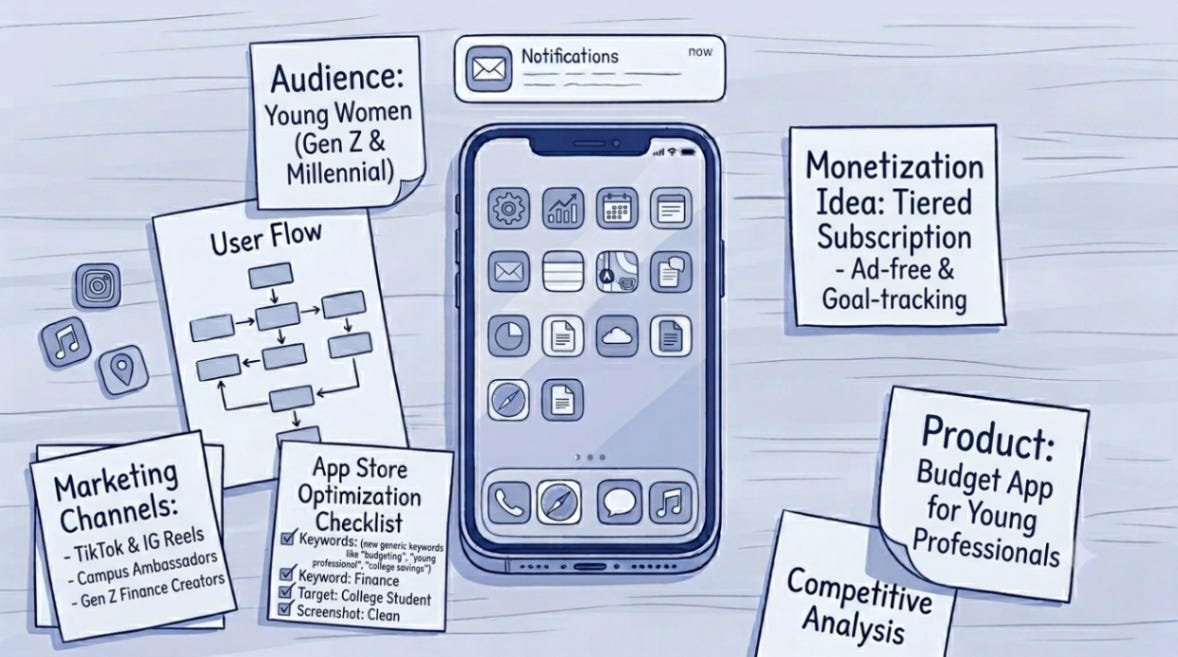
There are 1.8 million apps on the App Store, and most of them are built by men.
Your fav period tracker? Built by a man.
Your fav birth control reminder? Built by a man.
Your fav workouts app made for women? Built by a man.
And there are so many more of them.
For context, I spent four years at Apple Ads, supporting developers in promoting their apps on the App Store. I’ve audited hundreds of apps, managed millions in revenue, and logged more hours inside the App Store than I spent touching grass. Mobile growth is what I do, now as a Freelance Consultant.
And yet, when I decided to build my own app, I almost didn’t start. I did not lack ideas, nor did I misunderstand the market, since this is literally my job. But I hesitated because I was sure that building an app was something other people did: engineers, product managers, developers.
That story is wrong. Now, AI has just made it possible to prove it.

Welcome to Code Like a Girl, the community where women in tech come to be seen, heard, and championed as they walk this path together.
If you're a woman in tech who is done waiting for permission to build something, this is your community.
The Numbers Are Worse Than You Think
Developer Nation’s 25th global survey wave found that 75.7% of respondents identify as male and 23% as female. That’s just the headline figure, but looking at the indie app economy, it is even more skewed.
All-female founding teams account for just 5.4% of VC deal count in the US, and that’s after two decades of growth (according to PitchBook All In: Female Founders in the VC Ecosystem, 2024).
All-female founding teams received just 1% of total US venture capital in 2024, down from 2% in 2023. In Europe, it was 0.5% (PitchBook US Female Founders Dashboard).
Meanwhile, BCG research shows female-founded companies generate more than twice the revenue per dollar invested compared to male-founded companies. They build more efficiently, but they still raise less.
So what’s actually going on?
The Structural Issue
The coding myth was never for women
In male-dominated tech circles like indie hacker Twitter, YC founder communities, startup podcasts, forums... non-technical men are consistently encouraged to ship something, hire engineers, find a technical co-founder, and start. The culture normalizes figuring it out later.
Women in roles like product managers, marketers, ASO specialists, and growth leads often receive the opposite signal. The implicit message is: wait until you have the technical skills, or wait until you find someone who does. So we wait, and often, never start.
The financial runway gap is invisible but decisive
The funding gap is well-documented. Less discussed is the pre-funding gap: the personal savings, financial safety net, and risk tolerance required to spend months building an app with no guaranteed income.
According to the World Bank/UN Women report, women dedicate on average 2.4 more hours per day to unpaid care work than men. Those are 2.4 hours, not going into side project work.
Indie app development rewards people who can afford prolonged financial and time uncertainty. That’s structurally easier for men because of the systems around them.
The networks are male-dominated
Building an app isn’t just about code. It’s about App Store Connect, TestFlight, keyword strategy, a hundred small decisions where knowing the meta matters enormously. The communities where that knowledge lives skew heavily male. But the real issue isn’t only who’s in the room, it’s also about how the room works.
Let’s take the example of Dwarkesh Patel, who started a podcast in his dorm at 19, out of boredom. He cold-emailed economist Bryan Caplan, who became his first guest, and when Caplan spent a summer in the same city, they had lunch together nearly every day. A stranger called after his first episode to ask how much money he’d need to keep going for six months, then wired him $10,000. Doors kept opening for this young man.
But the mechanism is worth naming: an older man saw a younger man and thought I recognize myself in him. He opened his network with zero transactional threat attached.
A 19-year-old woman cannot assume the same dynamic. She cannot assume daily lunches will stay daily lunches. So she often doesn’t send the email, or spends energy managing what men never have to think about. The knowledge doesn’t transfer, and most doors stay closed.
I’ll say it plainly: most of the real opportunities I’ve had in my career came from women in decision-making positions who chose to open a door.
That’s why representation at the top isn’t only symbolic, it’s mechanical. And it’s also why men who actively notice this dynamic and act differently because of it matter.
What AI Has Actually Changed (And What It Hasn’t)
I want to be specific here, because most writing on this topic isn’t.
The old barrier stack for building an iOS app looked like this: learn Swift (years), learn Xcode (steep curve), understand App Store Connect (counter-intuitive), develop ASO knowledge (expensive consultants), hire a designer, implement monetization.
And if you get there, it’s only the start, because then you have to tackle distribution, which is itself one of the most difficult tasks. Each layer required either years of learning or money to hire around it.
What AI tools have genuinely removed is the brainstorming, coding barrier, and discoverability.
The brainstorming and validation
Before writing a single line of code, AI can now help you identify themes and ideas, investigate recurring pain points on Reddit, validate problem spaces, and map competitive gaps. You can know whether your idea has genuine demand before you invest a single hour building it.
The coding barrier
With vibe coding tools like Superappp, MWM AI, Rork, Claude Code... the list goes on, you can easily build a functional app by describing what you want in plain language and iterating on the output. SwiftUI, Apple’s UI framework, was already the most accessible framework Apple had shipped. AI on top of SwiftUI is legitimately usable for someone who thinks in product logic but has never opened Xcode.
Discoverability in the age of AI
ASO is basically SEO for apps, and essential if you want a product page that generates organic installs. Tools like Astro now have MCP to facilitate the process, which allows for easier tracking and understanding of ASO, competitor gap analysis, and metadata scoring built in. Getting a credible keyword strategy for your first app no longer requires hiring a specialist or an expensive tool.
To design assets for the store, like screenshots or icons, tools like AppLaunchpad, ChatGPT / Gemini for icons, and even Canva, have made these accessible to non-designers.
What’s left
What AI hasn’t removed: the thinking and the judgment. The domain knowledge about what problem is actually worth solving, and for whom. That’s good news, because women who’ve spent careers in product, marketing, and growth already have exactly that.
Bria Sullivan, a successful indie developer who built Focus Friend with the famous scientist Hank Green, was interviewed by RevenueCat (worth watching) and put it better than I could:
"The reason someone will be successful in an indie journey is not whether they're a good engineer or not. I think the reason that someone will be successful is their instinct for product and their instinct for marketing."That’s the unfair advantage most women in tech already have, and don’t know how to use yet.
I Built My First App and Here’s What Happened
This year, I’ve started building my own app for women.
A mindful spending app designed to pause before impulse purchases happen.
The idea came from my own life: I was spending money on things I didn’t need and feeling worse for it, not better. Things that were usually related to beauty, fashion, or care. Things I did not see my boyfriend having the urge to buy.
Let’s be honest, I am not a software engineer, and I have never been. My background is Mobile Growth and App Store Optimization. I understand how apps get found and grow, but I had no idea how they got built.
I used Claude and Superappp, to go from idea to a live app on the App Store. I wrote descriptions of what I wanted the app to do. I iterated on the generated code, shipped version 1.0, diagnosed and fixed a production crash in v1.0.2.
It is early, and the metrics are not impressive. But it is live, and I built it, and I did not wait for permission or a co-founder or a computer science degree.
And you don’t have to either.
Three Places to Start Today
Validate
Use Claude or ChatGPT to brainstorm around an interest of yours. Something you thought could be useful to you, in a specific context. Then analyze the top reviews in your target App Store category. Ask AI to surface recurring pain points, unmet needs, and frustrations. See whether your idea maps to a real and underserved complaint. Do this before you open any vibe coding tool or before you tell anyone about your idea.
Build
Prototype with Superappp, the most intuitive and design-friendly tool I’ve found. The goal is to build a functional first version by describing your app in natural language. Aim for TestFlight, not perfection. Shipping a broken v0.1 internally teaches you more about what your app actually needs to be than six months of planning.
Distribute
This is the step most founders skip and then wonder why nobody finds their app. Distribution is now becoming one of the most difficult parts of it all. It starts with your App Store page, continues on social media, and includes SEO tactics. Find where you’re most comfortable, and start from there to promote it. Read about app growth and the tools you might need for later. Follow people who work on apps, ask questions, and reach out.
The App Store has 1.8 million apps.
Most of them were built by men. That’s not because they have better ideas, but because the infrastructure of knowledge, capital, and community was built for them first.
That infrastructure is being dismantled by tools that make the technical barrier genuinely crossable for the first time.
The question is whether women will use them before the window closes.
I strongly believe we will. I think we already are.

If This Resonated With You
We're grateful to Julie Tonna for sharing her work here. She spent years inside the App Store ecosystem and then used that knowledge to build something herself, which is the kind of move most people only think about.
If you work in mobile growth or app marketing and want sharper thinking on what actually drives installs, follow her at Neo Ads.

You Belong Here
Julie put it plainly: the domain knowledge women in product and growth already have is an unfair advantage. Code Like a Girl exists for the women in tech who have that knowledge and are done waiting for someone to tell them they’re allowed to use it.
If you are not subscribed yet, that is the place to start. It is free.
You Don’t Need to Do This Alone
Have you ever wished you had someone in your corner who has actually been where you are?
When you go paid, you get direct access to Dinah Davis, founder of Code Like a Girl, via direct message. You bring your situation. She brings twenty years of having lived it. Together, you figure out your next move.
Once a month, Dinah shares practical steps you can act on right away. Not inspiration. Specific things you can do to advance your career when the system was not built for you.
Summer Out of Office
We’re taking two short breaks this summer: June 27 – July 7 and August 1 – 12.
Read Next


 | A guest post by
|
The point you make about the 2.4 hours of unpaid care work is the exact conversation we need to be having. The 'indie hacker' myth has always relied on the hidden assumption of infinite free evenings and zero caregiving responsibilities.
When people talk about AI lowering the barrier to entry, they usually just mean the technical barrier. But for women managing real exhaustion, AI is actually lowering the cognitive load barrier. It allows us to execute an idea without requiring us to become heavily caffeinated robots working at 2:00 am just to compete.
Getting someone to fund it? That's the next barrier.
Thank you for writing this piece Julie, and love your sharing around your own app development!
I have spent the past years in the app industry leading global app ecosystem partnerships at Google and prior to that in Google Cloud. It’s very true that developers are very male dominated professions and as a female that is non-technical, sometimes I found myself feeling uneasy in technical conversations.
As you mentioned app development involved multiple steps from ideation & fuding to development, distribution, ASO, marketing and creative to measurement; I do see different genders specialising across different stages based on their strengths and expertise. However what’s exciting is how AI is enabling solopreneurship which complements the gender gap on specific tasks.
I’ve been mentoring students which are already distributing multiple apps and it’s been very exciting!