

Your “Messy” Career Path Is Your Superpower
Why the years you spent in another field are worth more in tech now than they used to be.

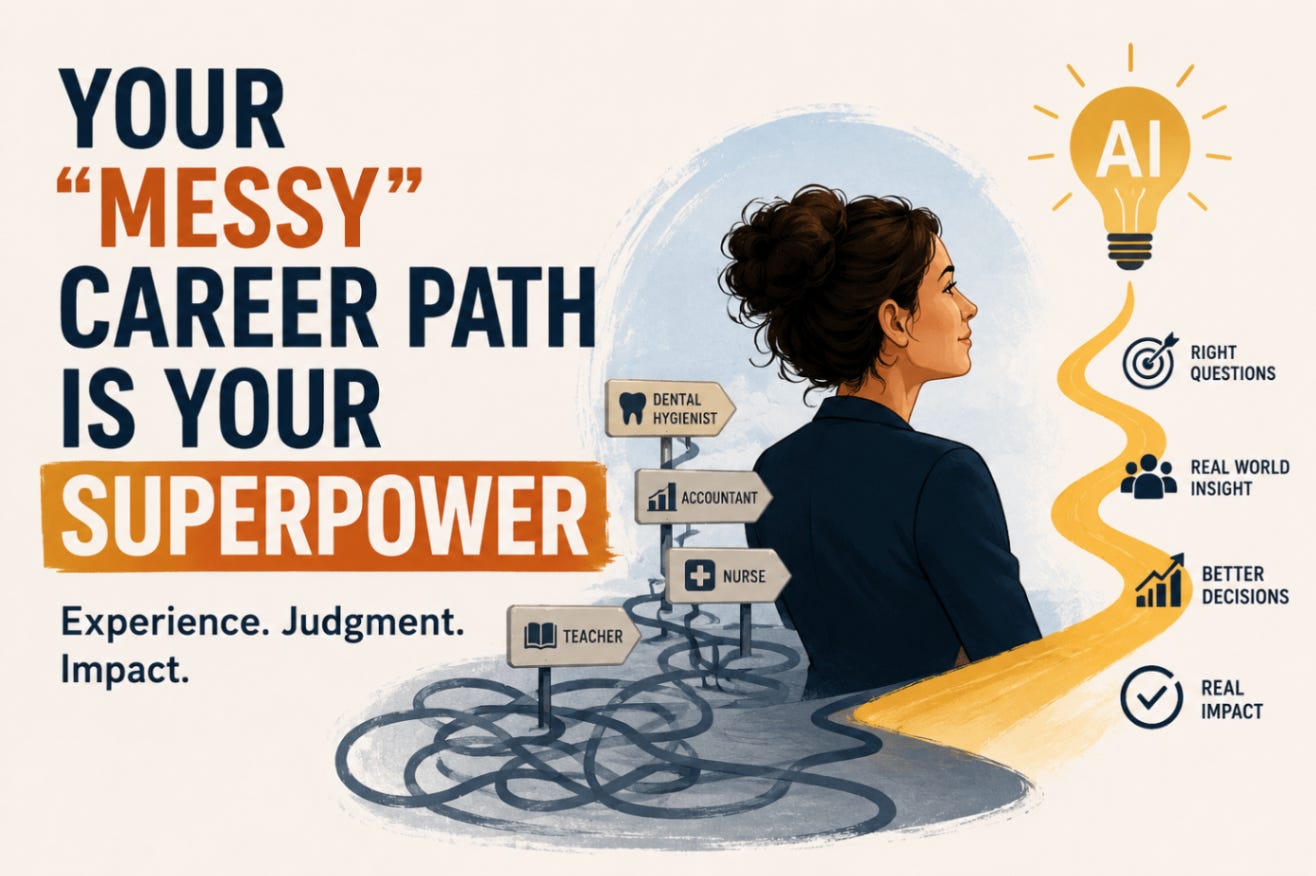
There is this idea that a career in tech has to look a certain way: study computer science, or maybe data science, get your first role, and build from there in a straight, upward line. It’s clean, logical, and optimized.
Most of us did not get that version.
Maybe you were a teacher, a nurse, a designer, or an accountant. Maybe you spent years becoming really good at something that had nothing to do with code. And when you finally made the pivot into data or tech, you carried all of that with you, a little unsure whether it counted for anything.
Here is what I want to tell you: it counts now more than it ever did.

Welcome to Code Like a Girl, the community where women in tech come to be seen, heard, and championed as they walk this path together.
If you are a woman in tech who took a winding road to get here, this is where you find the people who know that road was the point.
The Bottleneck Moved
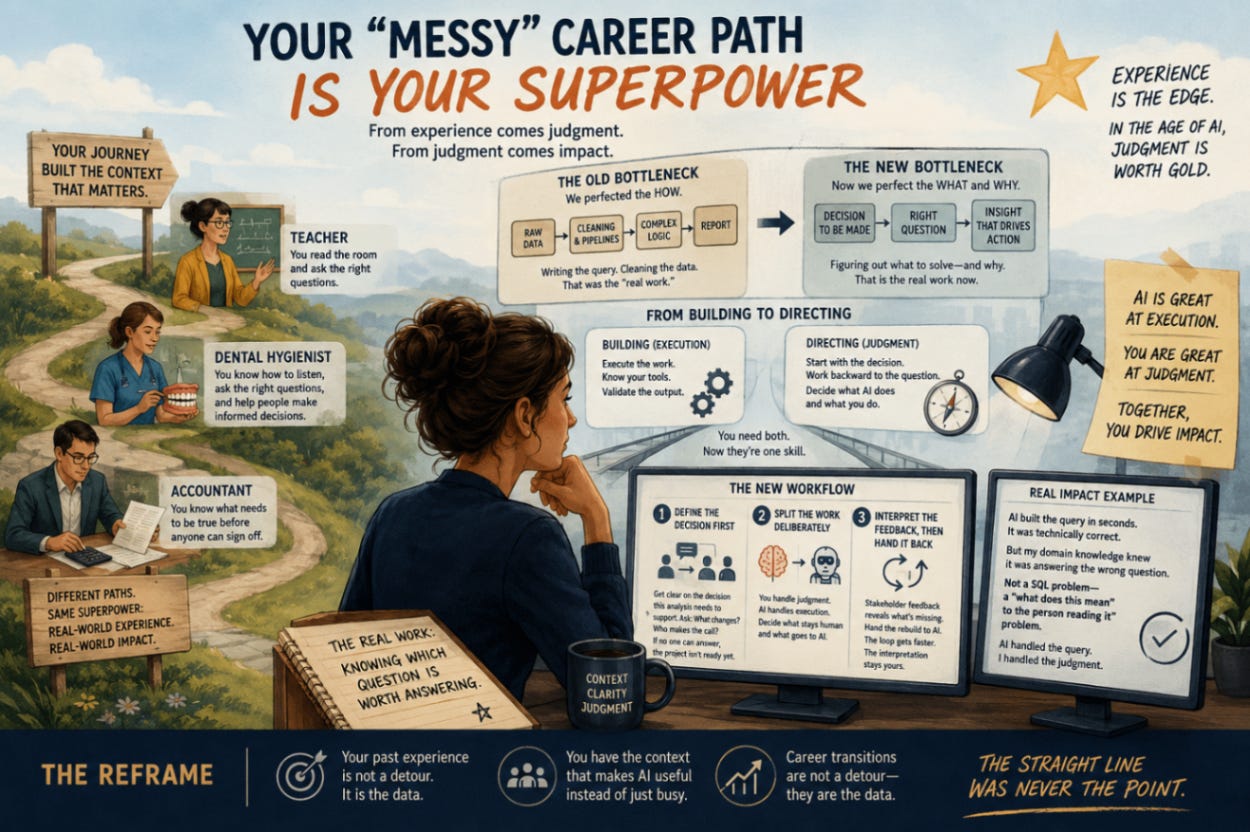
We’ve spent the last decade perfecting the ‘how’ of data: the pipelines, the cleaning, the complex logic. In the era of AI, that work moved.
What used to be the “real work” of writing the query and cleaning the data is now the pre-work.
What used to be the pre-work, figuring out what you are actually trying to solve before anyone writes a line of code, is now the real work.
That requires judgment. And judgment is built from experience, not from prompts. That is exactly where your old career stops being background noise.
If you spent years as a teacher, you already know how to read a room before you ask your question. You know that “what decision needs to be made here” is really code for “what does this person actually need to walk away knowing.”
If you were a dental hygienist, you already know how to handle a patient who is resistant to starting a new treatment. You know how to ask the right questions and communicate in a way that enables them to make informed decisions about their healthcare.
If you were an accountant, you already know to ask what would have to be true before anyone signs off, because you spent years learning that a number nobody can defend is a liability, not an answer.
These are not generic strategy questions. They are the exact questions you already know how to ask. You just have not had to ask them out loud in a data context yet.
When Your Previous Career Becomes the Superpower
It turns out that knowing which question is worth answering is one of the hardest things to learn. You cannot get there from syntax alone. You get there from having worked through enough messy problems and understood enough about how a field operates to know the difference between a question that drives a decision and one that just sounds interesting.
I came from clinical healthcare. I was a dentist in my home country and spent ten years as a dental hygienist before I ever touched SQL. When I made the transition into data, in my late 30s, I thought my background was a liability. Something to explain away in interviews.
The imposter syndrome was loud.
And when AI went mainstream, everyone realized how fast code could be produced. The moat of knowing how to write the perfect syntax slowly started to fade, and gave room to something else: knowing the impact of what your code is doing in problem-solving.
That kind of knowledge doesn’t come from a boot camp. It is built in the field, over the years, watching what breaks, what matters, and what people actually need.
A patient sitting in my chair didn’t know the meaning of ‘7mm pocket on number 15.’ They wanted to know what they had to do about it.
Was the tooth at risk? Did they need a deep cleaning, or just to floss better?
My job wasn’t reading the numbers; it was translating them into something they could act on, and doing it in a way that didn’t send them running for the door.
Stakeholders want the same thing. They don’t want “here’s your churn rate.” They want to know what it means for the decision they’re trying to make.
From Building to Directing
Building and directing used to be two different jobs. Now they are one skill.
The days of knowing code like the back of your hand are over. That gave room to something else: knowing which problems the code is actually solving. But that does not mean the code stopped mattering. You still need to know what your query is doing. You still need to know if the output AI is handing you is correct, or just confident.
You can’t direct something you don’t understand. What sits on top of that foundation is the harder skill: starting with the decision that needs to be made, working backward to the question that supports it, and then deciding how much of the execution to hand to AI and how much you need to handle.
And here is where your previous career stops being a footnote and becomes the whole point.
I had a request once for a report flagging patients overdue for a procedure. AI could build that query in seconds, and it did, technically correct, pulling exactly the date logic I asked for. But I knew enough about the clinical workflow to know the query was missing something: it didn’t account for patients who had already been contacted and scheduled, just not yet seen. To a clinician reading that list, every name on it would have looked like a gap in care. It wasn’t. It was a scheduling lag.
That distinction wasn’t a SQL problem. It was a “what does this number mean to the person reading it” problem. AI handled the query. I had to handle knowing the query was answering the wrong question.
AI is extraordinarily good at execution. But without that clarity of putting yourself in the “real world” shoes and understanding what is possible and what the limitations are, AI is just a hammer looking for a nail.
If you have spent time in the field, you will know which nail matters before you ever touch a dataset. That is not a soft skill. That is domain knowledge, and in the age of AI, it is worth gold.
What the New Workflow Actually Looks Like
Your domain knowledge is the asset. But it only becomes visible when you change how you work.
Define the decision first
Before you open any tool, get clear on what decision the analysis needs to support. This is where your previous career does its heaviest lifting, because you already know what a real decision looks like in the field you came from, and you know the difference between a question someone is curious about and a question someone actually needs answered to do their job.
I had a stakeholder once who wanted an answer to every question they could think of, all in one analysis. If I had just opened a tool and started building, I would have spent weeks chasing questions that didn’t matter. But because I had spent years in the field, I knew which one was actually urgent and which ones could wait. That instinct didn’t come from a dataset. It came from having spent enough time inside the problem to recognize the one question that needed an answer right now.
Use AI to do your research and ask questions:
what changes based on what this analysis finds?
Who is making that call?
If nobody can answer that, the project is not ready yet. That is not a blocker. That is information only you knew to ask for.
Split the work deliberately
Once you know what you are solving for, decide what stays human and what goes to AI. The execution, the query, the first draft of the visualization, a lot of that can go to AI. The judgment about whether the output answers the right question stays with you. This is the directing part of the job. You are not just using AI as a faster version of yourself. You are deciding what it touches and what it does not.
Interpret the feedback, then hand it back
When a stakeholder reacts to your output, something important happens in that conversation. They tell you what is missing, what does not feel right, and what they need.
Once you have that feedback, hand the rebuild to AI.
The loop gets faster. But the interpretation in the middle is yours.
The Reframe
The tools will keep changing. This part will not.
So if you are mid-career and wondering whether your background qualifies you to do this work, I want to reframe the question.
If you spent years in healthcare, education, finance, logistics, retail, or anywhere else where you had to understand a system from the inside, you have something increasingly hard to find. You have the context that makes AI useful instead of just busy.
And if you are already in data or tech and feeling disrupted right now, the same thing applies. The part of your work that AI is absorbing is the execution. The part it cannot replicate is what you know about your industry, your users, and the difference between a question worth answering and one that just sounds interesting.
Career transitions are not a detour. They are the data. They are what you know, and increasingly, what you know is the whole game.
The straight line was never the point.

We're grateful to Thais Cooke for sharing her work here. If you want writing that takes the parts of your career you were taught to apologize for and shows you why they are worth gold, follow her.

You Belong Here
Thais made the case that the years you spent in another field are the exact thing AI cannot replicate.
Code Like a Girl is the community for women in tech who stopped seeing their path as something to explain away and started treating it as the asset it is.
If you are not subscribed yet, that is the place to start. It is free.
Summer Out of Office
We’re taking a short break this summer: August 1 – 12.
Read Next


 | A guest post by
|
Oh how this hit. My advantage isn’t that I know more tools or technology. It’s that I’ve lived through enough change, mistakes, and hard-earned lessons to recognize what matters before the technology enters the picture.
We tend to forget how much judgment is built from the details of a life and career. That kind of experience shapes what we notice, what we question, and what we know not to rush.
I like the point that AI shifts the bottleneck from execution to judgment. But “messy” exposure across domains isn’t the same as real domain judgment.
Judgment comes from owning outcomes, risk, and trade‑offs over time – usually in leadership or high‑accountability roles – not just passing through different fields.
For most career‑changers, AI mainly narrows the execution gap. The true advantage shows up only when you already have deep domain context and accountability that AI can amplify