

Women Rising: The Pricing Gap Nobody Is Talking About
We analyzed pricing data for 426 writers on Substack’s Technology lists. The story isn’t what you’d expect.

Wait, didn’t June’s Women Rising post come out already on Friday?! Yes, yes, it did. We pulled some new pricing data while working on it, and it was too much to fit alongside everything else. We couldn’t wait until September. So here it is. Bonus Post!
If you’ve spent any time in conversations about women and money, you’ve heard the line: women underprice themselves.
The data we collected from Substack’s Technology Bestseller and Rising lists tells a more complicated story.
What We Measured
Since January, we have been tracking every writer who appears on the Technology Bestseller and Rising lists with weekly snapshots and manually determining gender.
Last week we added something new: pricing.1
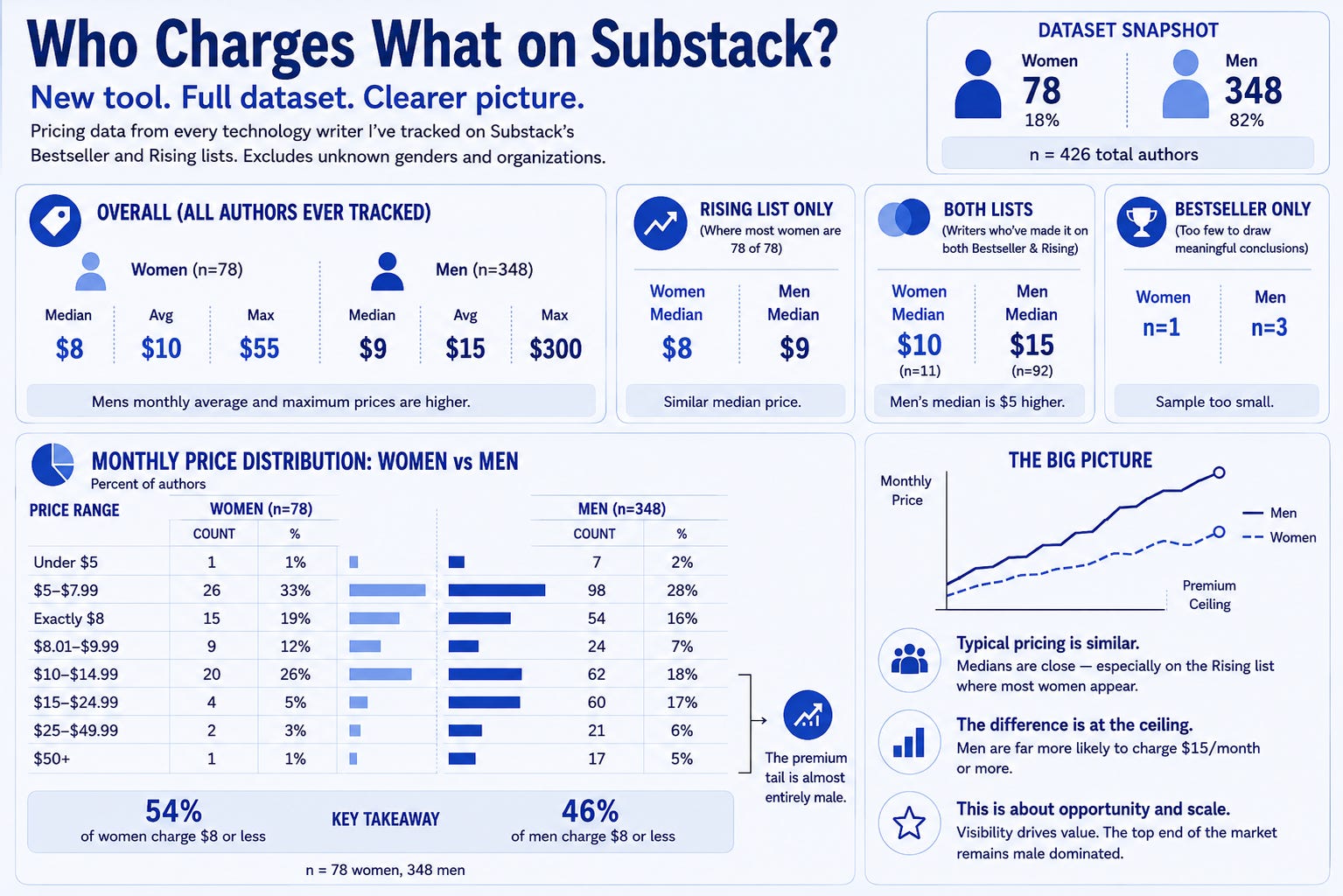
We now have pricing data on 426 writers: 348 men and 78 women.
Here’s what we found.
Across the Full Dataset, the Gap Is Almost Nothing
Women in our dataset have a median monthly price of $8, with men having a median monthly price of $9.
A one-dollar gap. Women writing about tech on Substack are not broadly underpricing themselves.
54% of women charge $8 or less per month. So do 46% of men. The typical woman and the typical man are charging very similar amounts.
The average tells a different story: $10 for women, $15 for men.
That gap is driven almost entirely by a small number of male-led publications charging professional consulting prices on topics like AI analysis, defense, semiconductors, and investing. Priced like business tools, not newsletters.
The highest monthly price from a man in our dataset is $300. From a woman, $55.
The Gap Opens at the Top
Among writers who have appeared on both the Technology Rising and Bestseller lists — the writers with proven momentum and sustained growth — the picture changes.
Women’s median monthly price in this group: $10.
Men’s median monthly price in this group: $15.
A $5 gap at the median among the most successful writers on the platform.
The premium tier tells the same story. 28% of men in our dataset charge $15 or more per month, while only 9% of women do.
The high-price tail is almost entirely male.
The ARR Problem
The Substack Bestseller list does not rank by subscriber count. It ranks by Annual Recurring Revenue (ARR).
That distinction matters.
A publication charging $15/month reaches the same ARR as one charging $10/month with 50% more paid subscribers.
If women are systematically pricing lower among the writers with the most momentum, they may need to build a larger subscriber base to reach the same list position as men charging more. We don’t have paid subscriber counts in our database, so we can’t confirm this. But it’s the right question to be asking.
Pricing is a flywheel lever. Price too low, and your ARR doesn’t compound even when your subscriber growth is strong.
What We Don’t Know
We want to be clear about the limits of this data.
We have a point-in-time snapshot, not pricing history. We don’t know if women who charge more see lower conversion rates. We don’t know whether the premium tier gap reflects audience expectations, niche differences, platform positioning, or something else entirely.
The data shows the gap. It doesn’t explain it.
What we do know is that the gap is real, and you're the one who gets to decide what to do with it.
The Question Worth Asking
The data suggests most women writing about tech on Substack are pricing at the standard newsletter rate. That’s not wrong. But the writers who have made it furthest are pricing higher.
If you have a paid tier, it’s worth asking: did you set your price once and move on? Is that price still right for where you are now?
We’re not saying you’re doing it wrong. We’re saying the data shows something worth thinking about.

You Don’t Have to Figure This Out Alone
The women on the Bestseller and Rising lists didn’t get there by accident, and they didn’t get there alone. They got there because someone recommended them. Someone shared their work. Someone in their corner said this is worth your time.
That’s what you need too.
A community that shows up for your work. That helps it travel. That makes sure it doesn’t disappear into a feed. That’s what Code Like a Girl has been building since 2016.
Three times a week, you get the tutorials, stories, and hard-won lessons of women in tech, all written by the people living it. Women Rising runs on the first Friday of every month. Each issue unpacks one lever that actually helps you build your flywheel.
If you’re not subscribed yet, start there. It’s free.
If you’re already here and ready to go deeper, Her Edge is a monthly paid column from our founder, Dinah. She spent twenty years in tech, hit that ceiling herself, and came out the other side as a VP who retired at 43.
Each month, she shares the specific frameworks that broke through it.
Summer Out of Office
We're taking two short breaks this summer: June 27 – July 7 and August 1 – 12. This is genuinely, actually, no-really-we-mean-it the last Women Rising newsletter until September. Weekly notes with the Bestseller and Rising list numbers keep going all summer long.

Women Rising: The Full Series


Future posts will be found here.
This analysis covers 78 women and 348 men who have appeared on Substack’s Technology Bestseller or Rising lists since late January 2026. Accounts with unknown gender and accounts representing organizations are excluded. Pricing data is a point-in-time snapshot. Founding tier prices were excluded from the main analysis due to extreme outliers on both sides.
This is super interesting. I’m tempted to draw conclusions — but it’s not entirely evident they’re under-pricing.
What’s missing is the demand side of the picture (I doubt — sadly — this data is readily available)
But I strongly suspect women writers on here have a heavily skewed female readership.
What’s the gender mix of Substack users overall?
Is there a gender gap in terms of willingness to pay and average spend for content across the platform? (Regardless of topic)
An alternative plausible explanation: they’re pricing “right”, but women — thanks to gender pay and leisure gaps — have less discretionary income and time — and are therefore harder to convert🤔 - I.e. A biased system rather than those writers lacking pricing confidence
I’d like to understand the “why” behind the lower price. One thing is the disproportion in wages, but other thing is proactively setting up the paid tier and dictating your own price. Every time this comes up that women are making less $$$ it deeply bothers me, I’d see the opposite trend. Because women are not less skilled, they just have less audacity.