

Helping Girls Stay in STEM: A Parent's Guide
Possibility, Identity, Contact, Permission. The four things that keep a girl curious long after the world tells her to stop.

Think back to when you were a girl.
Did you take apart something just to see what was inside?
Did you build elaborate structures out of sugar packets or whatever you could find to see if they would stand?
Did you ask "why" so many times that the adults around you ran out of answers?
Did you get a thrill every time you got to mix vinegar and baking soda together?
Did you stay up late reading about space, dinosaurs, or volcanoes because you just needed to know more?
Did you stare at tide pools for longer than anyone thought was reasonable?
Did you collect things you found outside so you could study them?
Do you remember when you stopped?
Was it the first time someone told you not to make a mess?
Or when a teacher looked right past your raised hand?
Or when you were told that science was for boys?
Or when it was cooler to say math was hard than to admit you liked it?
Or when someone told you, with complete confidence and zero malice, exactly what your future should look like, and you believed them?
I believed them. I told my high school guidance counselor that I enjoyed math, and he told me I should be a math teacher. And I listened.

I found my way to what I loved. Math, computer science, cryptography, and finally a career in technology doing all three.
I share this because if you are raising a girl right now, or teaching one, or mentoring one, you have the opportunity to give them something that we weren’t.
Confidence to follow their dreams.
That is what I tried to do for my daughter.

Welcome to Code Like a Girl, the community where women in tech come to be seen, heard, and championed as they walk this path together.
If you remember the girl you used to be before the world told her to stop, this is your community.
Code Like A Princess
This is my daughter at about 7 years old, coding like a princess!
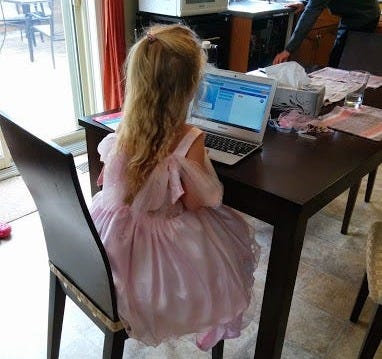
I loved every second of it. The princess dress, the coding, and the fact that no one told her that this was bucking every stereotype of what a person code should look like.
At seven, the world had not gotten to her yet.
She coded in a princess dress, made messes playing chemistry, mixed vinegar and baking soda more times than I can count, soldered circuits that made things light up, designed classrooms, constructed bird houses for fun, and built so much LEGO we had a dedicated LEGO-plated table.
She liked it, and so she did it.


I knew that could change dramatically in her teen years. I had seen the research. And I had lived the alternative.
I was going to do everything I could to prevent it.
TL;DR We did it. She is 17 now, and she just got accepted to her first-choice university to study biochemistry this fall. This is your guide for how you can do it for your daughter, niece, or girl in your life.
The Cliff Is Real. And It Is Still There.
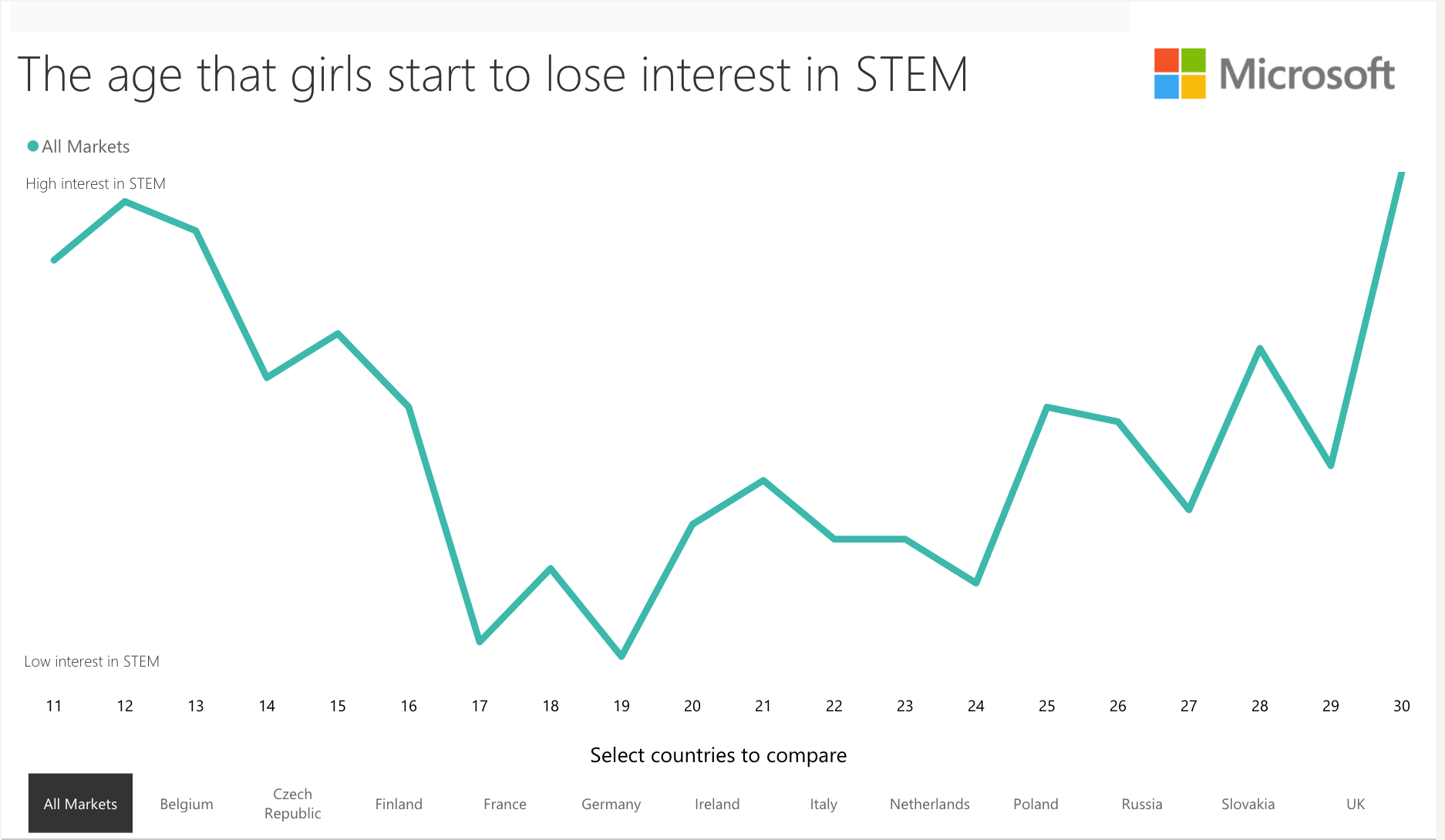
I first wrote about the STEM cliff in 2017 when my daughter was eight. At the time, a Microsoft study of 11,500 girls and young women across Europe had just found that interest in STEM peaks around age 11 and starts to drop by age 13.
Girls cited a lack of female role models as a key reason they didn’t follow a career in science or tech. Sixty percent said they would feel more confident pursuing STEM if they knew men and women were equally employed in those fields.
But here is the exciting part. By the time women reach their 30s, their interest in STEM returns to, and often exceeds, what it was at age 11.
The cliff is not permanent. The interest comes back!
What do girls at 10 and women in their 30s have in common?
They do not care what anyone thinks of them. They like what they like, and everyone else can stuff it.
The problem is the decade and a half in between, when caring desperately what other people think is basically a social survival mechanism.
Seven years later, a 2024 study by Ruling Our Experiences surveyed 17,502 girls in grades 5-12 across the US. It’s the largest study of girls and STEM ever conducted.
Here is what they found: girls’ interest in STEM has actually gone up since 2017, from 45 percent to 55 percent.
The efforts are working.
However, in that same period, their confidence has collapsed.
Only 59 percent of girls now believe they are good at math and science, down from 73 percent in 2017. On top of that, 58 percent of high school girls do not believe they are smart enough for their dream job, up from 46 percent in 2017. And worse among younger girls in grades 5 and 6, that figure has more than doubled, from 23 percent to 52 percent.
The 2023 Gallup survey of Gen Z backs this up from a different angle. Boys and girls report similar levels of enjoyment of science. The gap is confidence again, not interest. Gen Z girls are nearly 20 percentage points more likely than boys to say they are not pursuing STEM because they don’t think they would be good at it.
They are not walking away from science. They are being told, in a hundred small ways, that they do not belong there. And they believe it.
Neela 🌶️ wrote about the systemic side of this earlier this year, including the economics, the pipeline, and the structural failures that create this scenario.

But what I want to talk about today is what parents, aunts, uncles, and teachers can actually do.
Because I did it. And it worked.
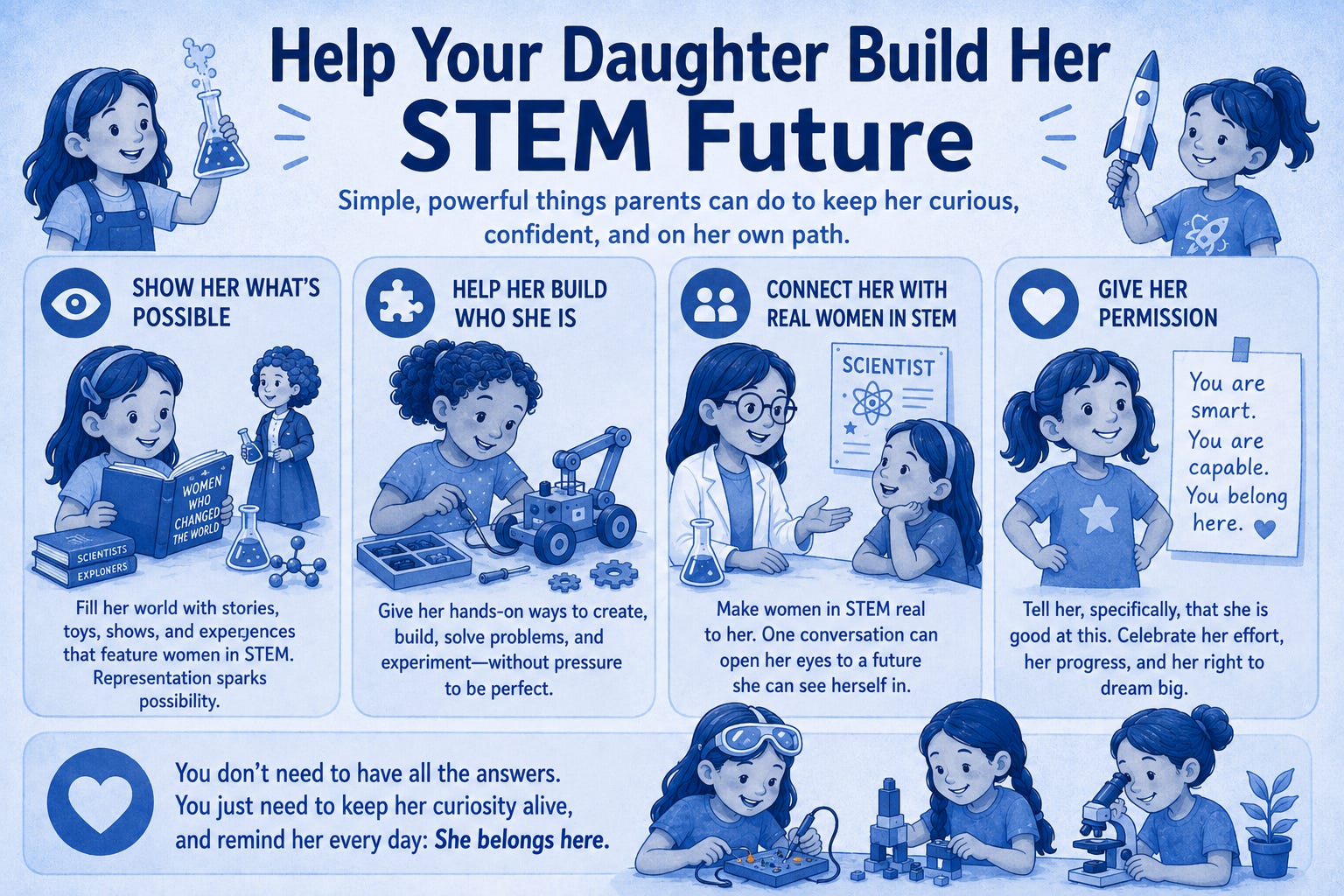
Possibility. Identity. Contact. Permission.
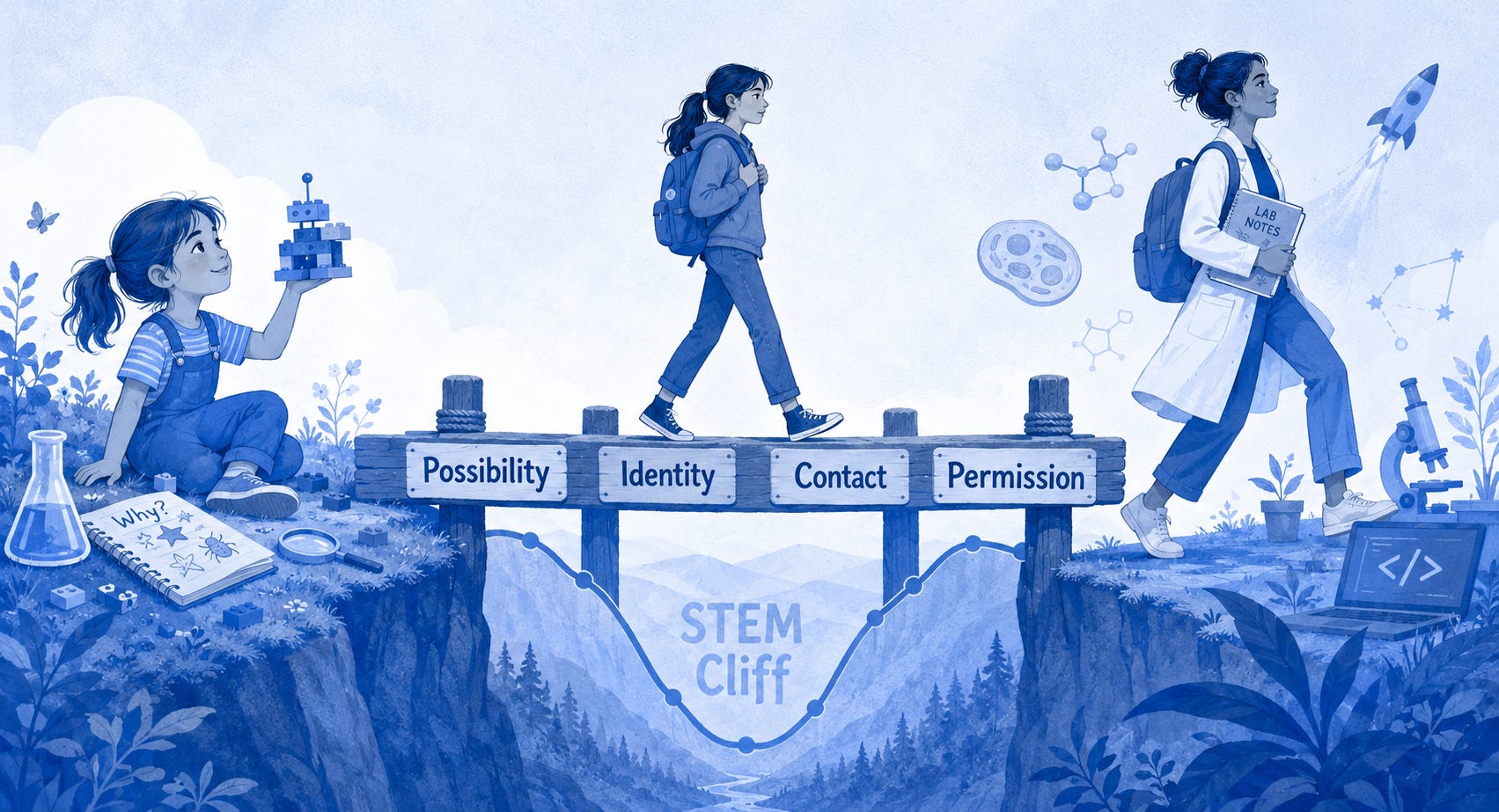
Girls don’t lose interest in STEM because they stop being capable. They lose interest because the social cost of keeping it goes up, right at the age when peer perception feels like survival.
You can’t fight that directly. What you can do is build something stronger underneath it, before the pressure starts, while she still likes what she likes.
It comes down to four things.
What she sees shapes what feels possible.
What she does builds who she understands herself to be.
Who she meets makes the path feel real.
And what she hears about herself specifically gives her the permission to walk it.
Possibility. Identity. Contact. Permission.
Surround Her With Possibility
She needs to see that women in STEM exist before she can imagine herself there.
Books
We read Goodnight Stories for Rebel Girls together and listened to their podcasts. Once, when she was about 9 years old, we got a new edition, she devoured the whole thing in a weekend, and then read it out loud to her cousins at the cottage later that summer.
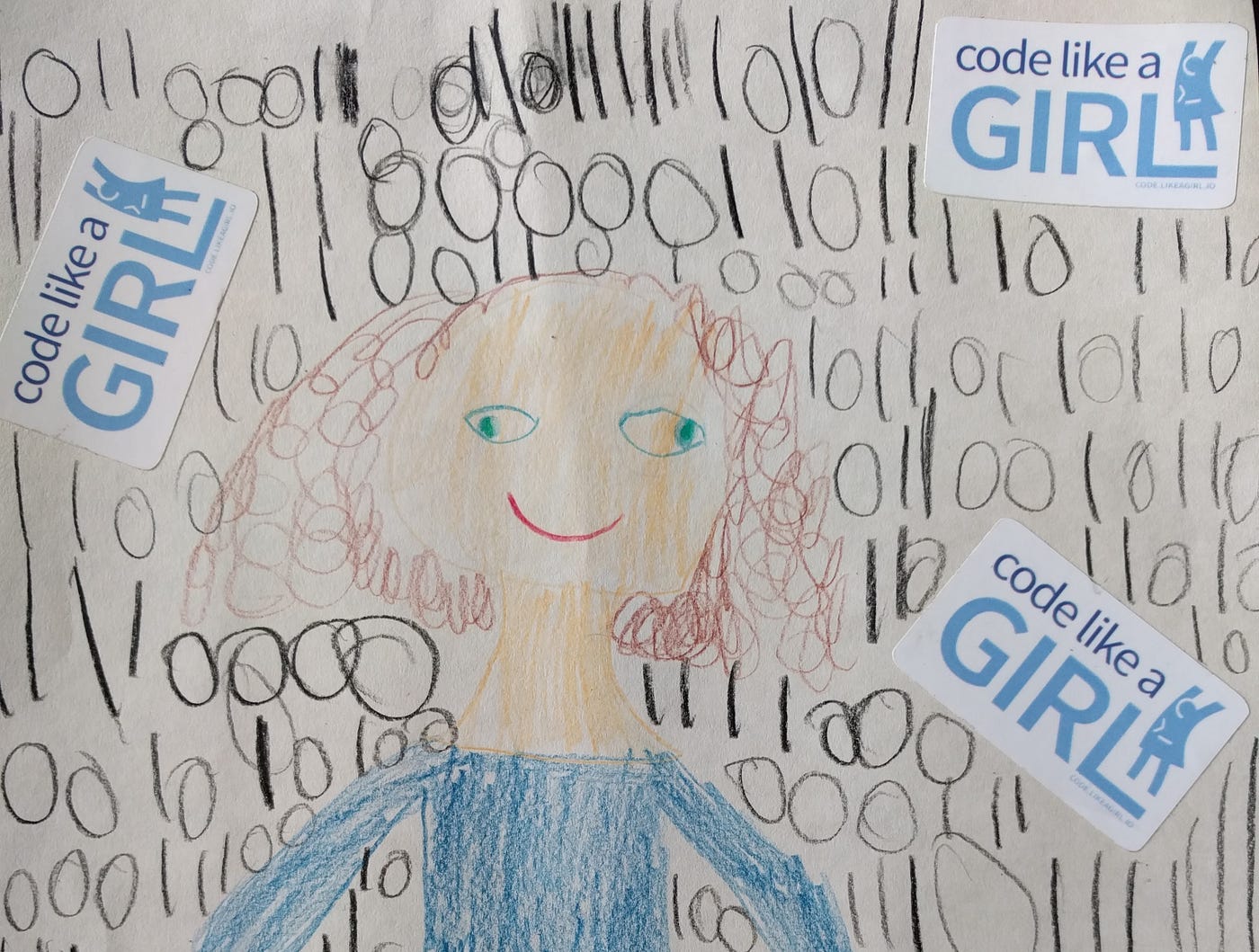
We also created our own Goodnight Stories for Rebel Girls book, where we wrote, and she illustrated the stories of the women in her family going back to her great-grandmother. This helped her see the wonderfully strong and intelligent women she came from.
Dolls
We filled her world with women scientists as characters in her imaginative play.
She had a Marie Curie doll from a company called Miss Possible. The first thing she did when it arrived was introduce Marie to her doll Chloe.
Chloe: “Hi Marie, I’m Chloe.”
Marie: “Hi Chloe, I’m Marie.”
Chloe: “Are you a scientist?”
And that was it. A scientist was now a character in her imaginative world.
She ended up with four dolls as Role Models: Marie Curie, Ada Lovelace, Bessie Coleman (the latter two created with generic store dolls with hand-knitted outfits by my mom after Miss Possible went under), and finally Penny Oleksiak.
Four dolls. A chemist, a mathematician, an aviator, and an Olympic champion.


You don’t need the exact dolls. You need her imaginative world to have a scientist, an engineer, or an aviator in it. One character that pushes gender norms. That’s enough to shift what feels possible for her.
Science and Exploring
Some of the best science learning happens at the kitchen counter or in the backyard. Chemistry kits, rock and geology sets, nature collection kits, anything that turns the counter or the backyard into a lab keeps her curious.
The goal isn’t to teach her chemistry. It’s to let her experiment, to keep alive the thrill she already has of making something happen and wanting to know why.
You can buy a kit or build one from what’s already in your kitchen. We let my daughter loose on the ingredient shelf to see what would happen. Baking soda and vinegar, of course, won every time.
Building and Engineering
Building is where she stops following instructions and starts inventing. Open-ended construction sets where she builds whatever she imagines, not just the picture on the box.
Magnetic shapes that click into three-dimensional structures.
Room-design kits she can wire with lights and motors.
Snap-together electrical circuits that require no soldering.
Woodworking kits designed for small hands.
Look for toys where the outcome is not predetermined, where she has to figure out what she is building and how.
That uncertainty is the point. That is where the engineering thinking happens.
You can also create these at home with cardboard, markers, scissors, and masking tape. It doesn’t have to be store-bought.
Coding and Logic
Some of the best coding lessons don’t look like coding at all. Board games like Robot Turtles, Potato Pirates, and Code Master teach programming concepts while she thinks she’s just playing. She moves pieces by reading conditional logic cards, plans several moves ahead, and slowly learns to think in sequences and rules.
That’s computational thinking, and she’s doing it on a rainy afternoon with the people she loves, long before anyone calls it computer science.
Math and Patterns
Math is everywhere in play, you just have to know where to look. Tile games like Qwirkle and Mexican Train Dominoes build pattern recognition. Puzzles like Katamino turn spatial reasoning into a race to fit the shapes together.
The best of these make mathematics visible as something close to art.
The girl who plays these on a Friday night is building the very same muscles she’ll use in calculus one day. She just doesn’t know it yet, and that is exactly right.
Movies and TV
We watched movies where women saved the day, solved the problems, and did the science. Shows like Wonder Woman, Hidden Figures, Ghostbusters, and Star Wars. These things shift what feels possible.
Over time, these shows change. Right now, something like K-Pop Demon Hunters is doing that work for a new generation of girls. Pay attention to what she is watching and lean into the ones where girls are the ones figuring things out.
The Santa Letter
When she was seven, she and I walked to the mailbox the way we did every day after school. That day, tucked in with the bills and flyers, was a letter from Santa. The kind Canada Post sends to kids who write in. She ripped it open the moment we got inside.
Then came this line:
“Mrs. Claus asked me to say Hi. She’s busy in the workshop fixing our toy-making machine. She has a degree in engineering from the North Pole University, so we rely on her when things act up.”
Her eyes lit up. She wanted to be a toy engineer.
Representation is important. One sentence about Mrs. Claus having an engineering degree changed what my seven-year-old thought was possible for her. It doesn’t need to come from Santa, you can write that sentence, she just needs to hear it.
Give Her an Identity Outside of School and Her Friend Group
Getting your daughter over the STEM Cliff means giving her an identity and space where it is ok for her to love STEM topics and practice them on a regular basis, with kids who also enjoy it.
School probably isn’t that place.
For us, it was Maker Club and STEM summer Camps.
The Maker Movement
The Maker Movement is one of the best tools available for keeping girls connected to STEM through the cliff years, and most parents haven’t heard of it.
The idea is simple: kids make things with their hands.
They sew. They build. They solder. They do woodworking. They make electrical circuits. They launch rockets made from pool noodles. They build toys with lights in them that require both wiring and craft.
The key is that there are no gender lines.
It is not crafts for girls and electronics for boys.
It is just making.
And when girls and boys are in the same room building the same things, STEM stops being coded as masculine and starts being coded as just something people do.
MakerClub was a huge part of our daughter’s early years, roughly ages 6 to 12. She learned to solder, to build circuits, to construct things with wood. She later went to a MakerClub summer camp, and eventually came back as a teen volunteer and counselor.
Look for Maker spaces and clubs in your area. Many libraries now host them. Many cities run them as part of affordable summer programming.
STEM Summer Camps
These are valuable specifically because they are outside of school and outside of her regular peer group. She is in a room with other kids who also think science is interesting. That normalizes it in a way that classroom science cannot, because the classroom is also where the social dynamics live.
The Engineering Science Quest (ESQ) Camp at the University of Waterloo is an excellent one if you are local to Kitchener/Waterloo. They cover a huge range of science topics in genuinely fun ways.
Many universities and colleges run these summer programs worldwide, so it's worth seeing what's offered near you. Libraries and children's museums are an underused resource here, too. Check what your local library, children's museum, and city recreation programs have before assuming it has to be expensive.
The goal is simple: find her a room, regularly, where the other kids think this stuff is cool too.
Contact — Make Women In STEM Real to Her
Reading about someone is different from meeting them. Hearing a woman talk about her actual work and seeing that she is a real person and not a myth is Gold.
Be That Person
I went into my daughter’s classroom and ran a learn-to-code workshop in grade four. Nothing formal. Just me, a projector, and a room full of kids who wanted to make a sprite move on a screen. She got to see her mom do the thing.
Encourage your daughter to ask women in your network not “what do you do” but “how did you get there.” That question opens up the path, not just the destination.
Find a Program
When my daughter showed interest in biology as a teen, we did a summer camp at the University of Toronto, where she got to stay in university residence and learn for two weeks from Graduate Students with other teens who were also interested in those topics.
Look for university programs in your area that offer residential science camps for teens. Seeing graduate students do real research can turn a vague interest into a clear direction.
Find Someone You know
You probably know more women in STEM than you think.
Last summer, a friend reached out. Her mom was a biochemistry professor at a local university, and she asked if my daughter would like a tour.
They stayed overnight, walked the campus, and spent real time with a woman doing the exact work my daughter was considering. She could see herself in that future because she had already met someone living it.
That visit didn’t come from a program or a guidance office. It came from a text message.
Ask your colleague if she’d spend twenty minutes with your kid. Reach out to the friend of a friend. Most people say yes.
For a girl standing at the edge of the cliff, one conversation with the right woman at the right moment can tip the scales.
Permission — What She Hears About Herself
This one matters more than any of the others.
Your daughter needs to hear “she can do this.”
Not that women can do this, or that certain women have done it.
That she can.
Give her permission.
Permission is the message that says: you, specifically, are good enough for this.
It isn’t that she needs anyone’s permission to pursue what she loves. It’s that she often believes she does. Society hands boys that permission by default. So tell her, out loud and often, that it is hers too.
This works in the other direction as well. A boy drawn to nursing, teaching, dance, or art needs the same words. Giving permission across the line is how the barriers come down on both sides.
My parents did this for me, and I made sure to pass it to my daughter.
We told her she was a good problem solver.
We asked what she was interested in and found programs that built on it.
We never focused on grades; we focused on doing the work and trying our best.
We asked if she was proud of herself.
We told her we loved how hard she was working.
When she got excited about medicine and biology as a teen, we found her a program for it.
When she worked hard, we named it.
When she got into biochemistry, we told her we were proud, not surprised.
The specificity is everything.
A girl who needs permission isn’t looking for general evidence that women succeed.
She already knows that.
She is waiting for someone to look at her and say:
You are good enough, smart enough, and strong enough to do this.
So when you see a girl with the curiosity and the drive, say it out loud.
“You are good at this.”
“You should apply for this.”
“I think you should go for it.”
Where We Are Now
My daughter is now 17. She took every science course her high school offered and pushed herself hardest in the ones she loved. This fall, she leaves for her first-choice university to study biochemistry.
For all my trying, she never did catch the tech or computer science bug. And you know what? That is perfectly fine. It was never the goal. The goal was that she would know the door was open if she ever wanted to walk through it.
I wanted her free to follow what she actually loved, even at 14, when the pressure to like other things was at its loudest. I wanted the cliff to pass her by.
It did.
None of that was luck. I was intentional from the very beginning.
Possibility. Identity. Contact. Permission.
I kept her world full of women who did remarkable things. I gave her years of building and tinkering, until making things was simply who she was. I put her in the same room as women doing the work, until the path was a person she had met. And I told her, specifically and over and over, that she was good at the things she loved.
Now she is off to become a scientist.
Here is what I most want you to take from this: I am not special, and neither is my daughter. I just paid attention, started early, and kept showing up. You can do exactly the same.
Start where your daughter is, with whatever she already loves.
Support it. Encourage it. Protect it. Then let her take it from there.

You Belong Here
If you read this nodding, already thinking about the girl in your life and what you’ll start this week, you’re exactly who Code Like a Girl is for.
This is a community of women in tech who found their own way to what they loved and want better for the ones coming up behind them. Real stories, hard-won, told by the people who lived them.
You Don’t Need to Do This Alone
Have you ever wished you had someone in your corner who has been where you are? One of my favorite things in life is mentoring people, helping them read the situation they’re in and figure out what comes next.
When you upgrade to paid, you get me as a virtual mentor via direct message. You bring your situation. I bring twenty years of experience in tech and years of mentoring women through exactly these moments.
Once a month, I also publish Her Edge, which gives you practical steps you can act on right away. Not inspiration. The specific moves that advance your career when the path wasn’t built for you.
Summer Out of Office
We’re taking two short breaks this summer: June 27 – July 7 and August 1 – 12.


This is excellent, Dinah. It's practical, systematic, encouraging rather than directing. Respectful of interest, open-ended, well-informed by *actual* science history rather than the Great Man hagiographies. It's as close to best practice as I could imagine.
It's not just first-rate intellectual parenting. It's good citizenship. My compliments. It's a pleasure to know you.
Loved this article.
"Surround her with possibility" is the best advice for any parent of young girls, no matter what they choose to pursue. Show them their choices are limitless before society does the opposite.