

Women Rising: Build the Flywheel. The Badge Follows.
Karo Zieminski started Product with Attitude with zero followers. One year later, she's on the Bestseller list. Here's how she built it.


You’ve probably seen the Bestseller badge
That small checkmark next to a writer’s name on Substack. It’s visible on their profile, in Notes, and in comments. It signals that hundreds, or thousands, of people pay for that writer’s work.

The badge is real social proof. When a reader lands on your profile and sees it, they arrive knowing over 100 people trust what you have to say enough to pay for it. They are more willing to stay, subscribe, and pay.
But here’s what most people get wrong about it.
The badge doesn’t drive your growth. It reflects growth that has already happened. Substack describes it as a credibility signal — and that’s exactly what it is. Recognition, not distribution.
There’s no official documentation that it changes how Substack distributes your work. No confirmed feed ranking benefit. No guaranteed Notes boost.
The badge tells readers that other people have already decided your work is worth paying for.
What actually drives growth is your flywheel. Content that earns readers. Engagement that builds trust. A paid tier that converts the readers who are ready. That cycle, spinning consistently, is what generates paid subscriber growth.
Getting on the Rising list is an early signal that the flywheel is working. The badge is a signal that it crossed 100 paid subscribers along the way. The Bestseller list, the top 100 publications in a category ranked by annual recurring revenue, is a signal that it has been working for a while.
The Rising list, the badge, and the Bestseller list. None of them is the goal.
They are what happens when your flywheel works.
If you’re new to Women Rising, we track Substack’s Technology Bestseller and Rising lists to understand why women writing about tech are underrepresented on both. Under 13% against a 22% industry average.
Each month, we focus on one lever that helps close that gap.
Technology Bestseller and Rising Lists Update
Eighteen weeks in. The Bestseller line has barely moved. Women have held between 9% and 11% of spots since late January, and have sat at exactly 9% for twelve consecutive weeks.
That stagnation isn't a conversion problem. The publications at the top of that list have been spinning their flywheels for years. Their position reflects accumulated momentum. It's not a door closed to newcomers. It's a measure of how long their flywheels have been running.
The Rising list is different. It peaked at 21% in late February, the closest we’ve come to matching the 22% women represented in the tech industry. It dropped, recovered, and ended May at 18% with the second-highest point we’ve recorded.
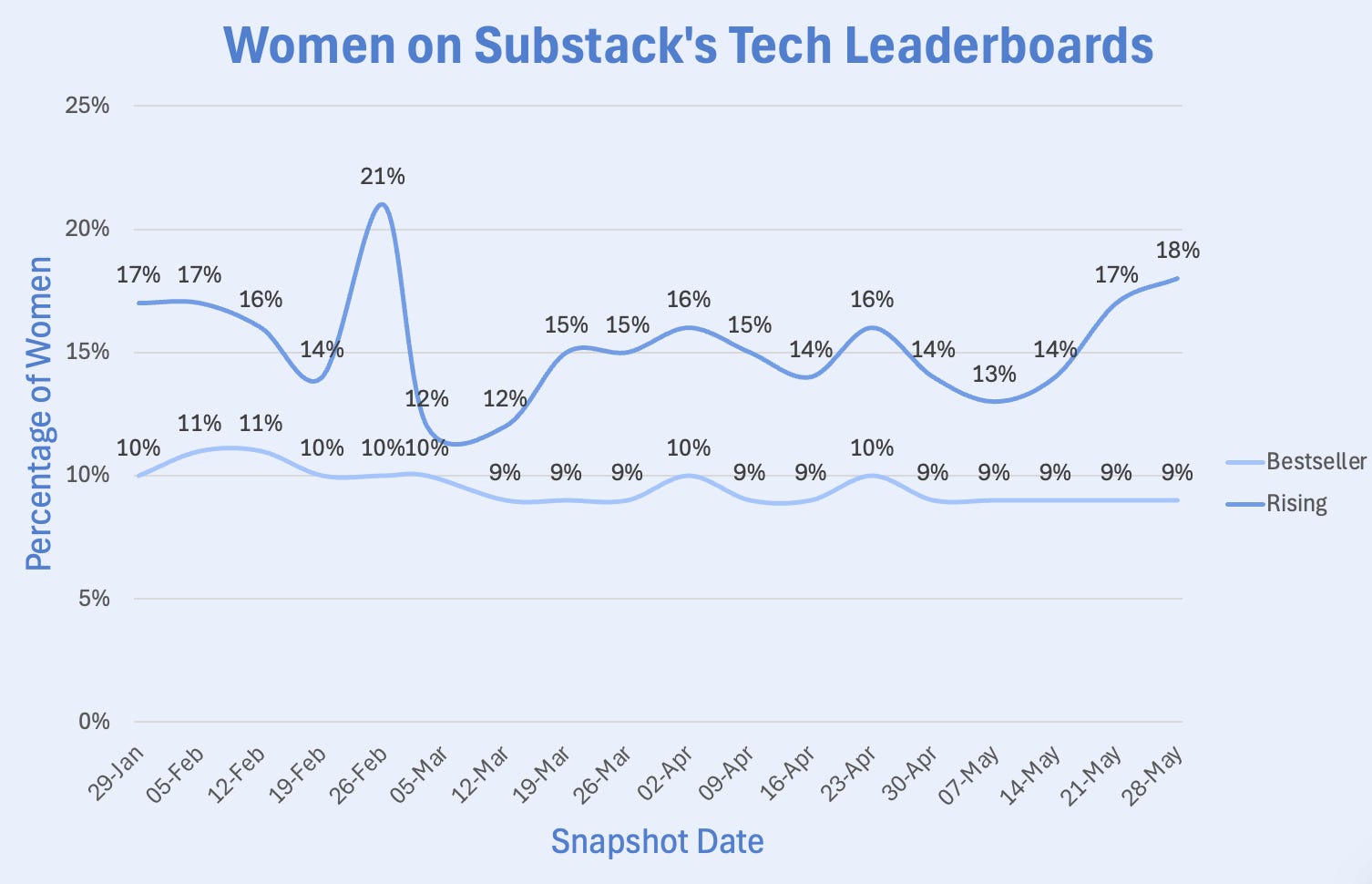
Momentum is possible. Women who launch paid tiers and build their flywheel are showing up on Rising. Last month, we shared that 4.5 more men enter the Technology Rising List than women, but when they are there, they stay at the same rate that men do.
The entry gap is real, but it's not the whole picture. Which is exactly what Karo's story shows.
The Interview
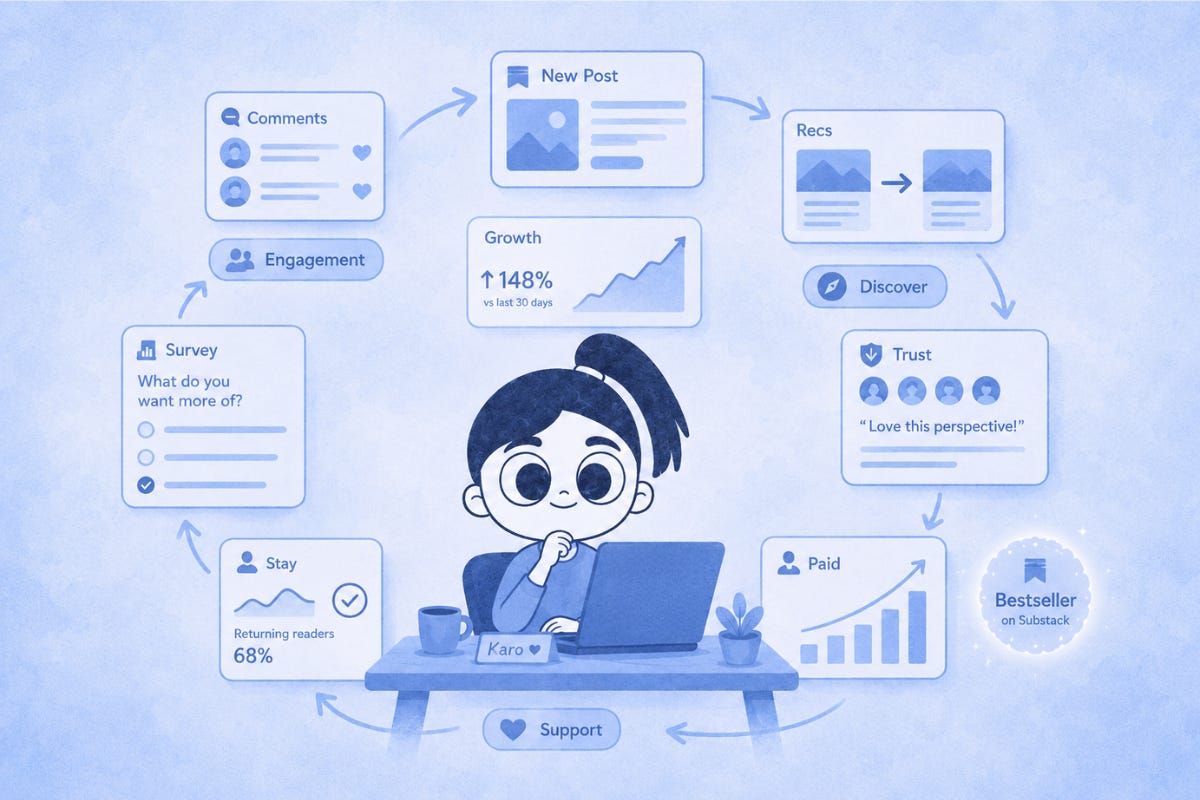
Karo Zieminski started Product with Attitude just over a year ago with zero followers.
Not just zero Substack followers. Zero followers anywhere.
Product with Attitude was her first time writing publicly. No existing audience to port over. No head start.
Today, she leads a community of 18,000+ subscribers, holds a Bestseller badge, and is a fixture on the Education Bestseller List.
She didn’t optimize for the badge. She built the flywheel levers methodically and with data, and the badge showed up when the flywheel was spinning fast enough. She is the thesis in practice.
We asked her how.
Dinah
Karo, I have been following you for awhile, since before we expanded Code Like a Girl to Substack.
One thing I noticed from your writing is that you analyze everything. You’ve tracked your interactions, run surveys, monitored which posts drove paid conversions, and mapped your engagement against your growth.
Before we get into tactics, when did you start thinking about your Substack as a system to build, rather than a newsletter to write?
Karo (Product with Attitude)
Thinking in systems seems to be my default setting for everything, heheh 😂 And as a PM, I’m used to testing things, killing beloved ideas, and pivoting when reality disagrees with my ego. So it felt natural to apply the same methodology to Substack.
From the outside, it looks like writing a newsletter.
But once you’re inside it, you realize it’s a product, a community, a distribution system, and a tiny business all at once.
I share more details in my recent article: Publication as Product.
She built a mental model first. The tactics are downstream of that.
Dinah
Let’s go back to the beginning. You launched a paid tier. A lot of women we talk to delay that decision, waiting until they have more subscribers, better content, and a clearer offer. You wrote an entire post about mistakes you won’t repeat, and “waiting too long” shows up in the subtext of a lot of them.
What made you launch when you did, and what would you tell someone who’s still waiting?
Karo (Product with Attitude)
Oh, I can definitely relate.
Before I launched my paid tier, I analyzed what more established writers in my space were doing, and the first thing I noticed was that they had time on their side. They had archives, recurring formats, proof, trust, and offers that had evolved over the years. As a newbie, I couldn’t compete with that directly.
But even if I had all of that, the hardest part was emotional. When I looked at my subscriber list, I saw two groups: people I knew almost nothing about, and people I had become friends with on Substack. I didn’t want to “sell” to the second group.
Three things finally pushed me.
I was reading Yana Y.G., who encourages everyone to monetize early.
I started getting comments and DMs from people nudging me to launch.
And I built StackShelf, which gave other writers a place to promote their work.
So I wasn’t just writing anymore, I was building value around the community.
My advice is this: don’t wait for the perfect offer.
Start with version 1.
We all improve it as we learn.
The emotional barrier is the real barrier. Tactics come after you clear it.
Dinah
When you launched, what did you actually put behind the paywall and how did you decide? Was it a specific offer, a content type, or access to something? And looking back, would you do it differently?
Karo (Product with Attitude)
First, I made StackShelf part of the paid offering.
Then I started mixing content. Free articles became the front door: they bring in new readers, build trust, and show how I think. Paid articles became the deeper layer for people who want the exact workflows, prompts, code, templates, and experiments behind the public piece.
Nobody wakes up excited to pay for “premium content.” They pay because you save them time, or money, or bring value in other ways.
She didn't launch with a perfect offer. She launched with version 1.
That's the whole point.
Dinah
Your data shows that 53.2% of your paid subscribers — 140 out of 263 — converted the same day they became free members. That’s a remarkable number.
Did you design for that, or did you discover it after the fact? What does that tell you about the moment someone decides to pay?
Karo (Product with Attitude)
I discovered it after the fact.
I started using StackContacts, a CRM built by Finn Tropy, and it let me look at subscriber data from angles Substack doesn’t really show you. That’s where I saw that 53.2% of my paid subscribers had upgraded the same day they became free members.
At first, that number looked amazing. But there was a downside.
In my experience, same-day upgrades are also more likely to unsubscribe.
That tells me some of them were probably impulse buys, or people who wanted one specific thing behind the paywall and didn’t yet feel connected to the wider publication.
So the lesson for me is that curiosity can drive conversion, but trust drives retention.
Curiosity converts. Trust retains.
Those are two different jobs, and they need two different strategies.
Dinah
You found a 0.907 correlation between community engagement and your growth.
Almost perfect.
What does that engagement actually look like for you? You’ve mentioned commenting in school parking lots and listening to Lives while making dinner.
How do you protect that time when you’re also publishing, building StackShelf, and running Attitudevault?
Karo (Product with Attitude)
Heheh, protect what? 😂 Not well, that’s for sure. I’m still learning how to protect my own capacity without becoming unavailable.
This is where my obsessive character works for me and against me.
I want to be there for the community, so engagement often happens in the cracks of real life. And I want to reply thoughtfully, read what people share, sending traffic back their way. The more PwA grows, the more DMs I get, and some of them require real thinking time before I respond.
I can’t always answer quickly (as you know), but I always respond.
She doesn't have a perfect system. She shows up anyway. That is the system.
Dinah
You exchanged recommendations with 163 publications and had a 98.8% success rate. But you also said waiting to ask was one of your biggest mistakes.
What held you back, and what changed when you finally started asking?
Karo (Product with Attitude)
Imposter syndrome!
You look at these huge publications, then at your tiny one, and you think: there’s no way they’d recommend me. I should wait until I’m bigger, better, more legitimate, more whatever.
But I realized something obvious: everyone wants to grow on Substack. And everyone includes big publications.
Everyone wants to grow. Even the big ones. Asking isn’t a favor. It’s a mutual offer.
Dinah
LinkedIn is something you mention as a turning point. When you finally messaged your professional network, your subscriber base nearly doubled in two to three weeks.
You’d known these people for years. What stopped you from doing it sooner, and how did you approach it when you finally did?
Karo (Product with Attitude)
I had treated LinkedIn like a reputational risk when it was actually one of my strongest trust channels. When you work in corporations for years, you build a reputation slowly. People know you through projects, meetings, delivery, judgment, and reliability.
Sharing a Substack felt different. It was more personal, more public, and much more “here is my actual brain”. When I finally reached out, I framed it as a personal update: here’s what I’ve been building, why I care, and who it helps.
She reframed LinkedIn from reputational risk to a trust channel.
That one shift unlocked years of relationship capital that was already there.
Dinah
You ran a survey with a 6.91% response rate, rare territory by any measure. One of the things you learned was that 53% of your readers go to Activity first, not Home. That single insight changed how you thought about distribution. The comment matters as much as the post.
How has that shaped what you actually do each day?
Karo (Product with Attitude)
It validated what I already suspected: comments are a growth channel in themselves.
And a beautiful one: you show up for other writers, help their posts travel, add something useful to the conversation, and stay visible to readers who already care about similar ideas.
So I try to comment as much as I can, but only if I can bring something to the conversation. A good comment is not “great post!”. It should add something: a question, a useful angle, a personal reaction, or a connection.
A good comment is distribution. It shows up where your readers already look.
Dinah
You use StackContacts with Claude Cowork to analyze subscriber behavior in ways Substack’s native dashboard doesn’t allow. What questions are you now able to ask about your paid subscribers that you couldn’t ask before, and what have the answers changed about how you run things?
Karo (Product with Attitude)
Some of the questions I can now ask are:
How long does it take readers to upgrade to paid?
Which articles have the highest unsubscribe rate?
Of the top three articles with the highest unsubscribe rate, what did engagement look like?
This was one of the biggest surprises. Some of those articles had strong engagement inside Substack, but still caused non-Substack readers to unsubscribe. I wrote more about this here.
Dinah
Keeping paid subscribers is as important as getting them. What do you do specifically to keep people paying month after month? What’s worked, what hasn’t?
Karo (Product with Attitude)
I need to consistently provide new value. People don’t stay paid because you once wrote something good in March, and everyone agreed to remember it forever.
What works best for me is staying close to my readers: reading replies, asking questions, reading what they write about, watching what paid members engage with, and looking at patterns in upgrades and unsubscribes.
But I don’t have it all figured out, and I’ve made some bets that didn’t work as well as planned.
Staying close to your readers is not a soft skill. It’s your retention strategy.
Dinah
You write about AI, product management, and building tools, which is all deeply technical territory. But you’re on the Education Bestseller list, not Technology.
Why did you choose Education as your category, and what does it mean for those who find you?
Karo (Product with Attitude)
I chose Education because Product with Attitude is not really about technology for technology’s sake. Yes, I write about AI, product management, tools, workflows, and building. So Technology would make sense. But the deeper purpose is AI literacy. And AI literacy is education.
The category isn’t about what you write. It’s about why.
Dinah
You’ve said your rule for tools is: automate anything that doesn’t need your judgment, never automate anything that does.
How do you apply that to your Substack specifically? What do you automate, what do you protect, and where do you draw the line?
Karo (Product with Attitude)
I love this question! I automate the admin, protect the judgment.
Things I automate:
generating ALT text for images
bringing subscribers in from Gumroad
analyzing stats
spotting patterns
research
Things I’ll never automate:
comments, replies, or real engagement.
The automation rule doubles as a relationship rule.
Protect the things that actually build the connection.
Dinah
You discovered that your most popular post and your most valuable post are not the same thing. The Claude Skills post was your most viral. Vibecoding Tips was what your readers said felt most valuable.
What did that teach you about how to think about what you publish?
Karo (Product with Attitude)
It taught me that popularity and value are related, but they are not the same metric.
The Claude Skills post was viral because it hit a moment. People were curious, the topic was timely, and the post was easy to share because everyone was trying to understand what Skills meant. That kind of post is important. It brings people in. It helps with discovery. It gives the publication reach.
But Vibecoding Tips was different. Readers said it felt more valuable because it helped them do the work better.
So the lesson was: I need both.
Viral brings people in. Valuable keeps them.
Plan for both, and don't confuse one for the other.
Dinah
Last question. You started at zero a year ago. You’re now on the Bestseller list. If someone reading this has just launched their paid tier and has their first ten paid subscribers, what do they need to focus on right now?
Karo (Product with Attitude)
Before I answer, I want to be clear: I’m not a growth guru.
My advice may be total crap for someone in a different niche, with a different audience, at a different stage. But I’d say this: don’t give up.
Of the people who started around the same time I did, 80% have already left Substack. When things get hard, many people disappear. If you keep showing up, keep learning, and keep making the work useful, staying becomes an advantage.
Before I go, I want to say a few words to Code Like a Girl.
I’m grateful for the work you do. Thank you for bringing women’s stories to the surface, helping us get to know each other, and creating a space where our work is seen and taken seriously.
You’re an inspiration to me and to so many others.
And thank you for taking the time to run this interview.
Build Your Flywheel
Karo’s flywheel is made of specific levers. Here's how she built it:
Launching paid before she felt ready
Asking for recommendations before she felt big enough
Treating her professional network as a trust channel, not a reputational risk
Commenting every day, in parking lots and between meetings
Surveying her readers and changing what she did based on what she heard
Using data to ask questions that Substack’s dashboard doesn’t ask
She appeared on the Education Rising list when a few of those levers started turning the flywheel.
The badge showed up when enough of them were running at the same time, starting to build momentum.
Her position on the Education Bestseller list, 84 at the time of writing, is what happens when you double down on what's working and the flywheel spins faster.
Pick one of these. Not all of them. One. Start this week.

Thanks so much to Karo for taking the time to share these insights with us. Be sure to subscribe to Product with Attitude. Karo also builds StackShelf.app and Attitudevault.dev, so be sure to check them out too.
You Don’t Have to Figure This Out Alone
The women on the Bestseller and Rising lists didn’t get there by accident, and they didn’t get there alone. They got there because someone recommended them. Someone shared their work. Someone in their corner said this is worth your time.
That’s what you need too.
A community that shows up for your work. That helps it travel. That makes sure it doesn’t disappear into a feed. That’s what Code Like a Girl has been building since 2016.
Three times a week, you get the tutorials, stories, and hard-won lessons of women in tech, all written by the people living it. Women Rising runs on the first Friday of every month. Each issue unpacks one lever that actually helps you build your flywheel.
If you’re not subscribed yet, start there. It’s free.
If you’re already here and ready to go deeper, Her Edge is a monthly paid column from our founder, Dinah. She spent twenty years in tech, hit that ceiling herself, and came out the other side as a VP who retired at 43.
Each month, she shares the specific frameworks that broke through it.
Summer Out of Office
We're taking two short breaks this summer: June 27 – July 7 and August 1 – 12. Women Rising is pausing for July and August, but we're not going quietly. There's a bonus issue dropping this Sunday before we do.
Weekly notes with the Bestseller and Rising list numbers continue all summer.
From Our Substack Community
The Girlbossification of AI Has a Friendly-Fire Problem

Reese Witherspoon gets pile-oned for saying women should learn AI. A designer loses subscribers for experimenting with it in her own work. A Claude Code learning session runs 27 people, three women. The discourse says adopt AI or get left behind. The comment section says resist. Both are wrong. The obstacle isn’t only the tech industry. It’s closer than that.
Taste Is Not a “New” Core Skill

Tech bros didn’t discover taste. They discovered that AI made execution cheap. Sarah Gibbons and Kate Moran show why judgment, context, articulation, and pattern literacy have always been core skills. And why the people who’ve been forced to justify their work for years may be the ones best equipped for what comes next.
Facebook Fired Me for a Holiday I Didn’t Take.

Louise Deason was fired from Facebook for taking a holiday she never took. The access logs, travel records, and performance reviews could have proved it in minutes. Nobody checked. This is a sharp, necessary story about how tech firings really work, and why the official reason is often just the cover story.
From Our Medium Community
The Lies Engineers Tell PMs by Tiffany Bayton
“Shouldn’t be too bad” is not an estimate. It’s an engineer silently watching a dependency graph appear behind their eyes. Tiffany Bayton captures the hidden complexity inside every “small” product request. And why the most useful answer in tech is sometimes: let me investigate first.
I Thought Dark Mode Was Just a Toggle. It Turned Into a Full-System Refactor by Marsha Teo
Marsha Teo thought dark mode would be a toggle. It turned into a full-system refactor. Hardcoded colours, typography defaults, code highlighting, SVGs, images, and rendering timing all had opinions. A smart, practical reminder that “small” UI features are only small until they touch the whole system.
Leading Leaders? Shift Your 1:1s from Status to Strategy by Sivan Hermon
A 1:1 with a leader shouldn’t be a status meeting in disguise. Sivan Hermon shows how to use that time to talk about feedback, people, priorities, and the systems quietly shaping the team. It’s a smart, practical template for turning manager 1:1s into a place where leadership actually gets sharper.

Women Rising: The Full Series


Future posts will be found here.
 | A guest post by
|
Thank you, thank you, thank you Dinah!!! 🤗
Karo, your articles and posts are so insightful, and this piece was no exception.
I felt this interview was a breath of fresh air compared to all the "Get 10k followers in 2 weeks" posts, which honestly feel so fake. There are times when I would feel behind on my Substack journey. But reading about all the doubts and hesitations that you went through and then took the small leaps anyway, somehow makes me feel human and normal again. Thank you for sharing your journey with us! Always an inspiration!